


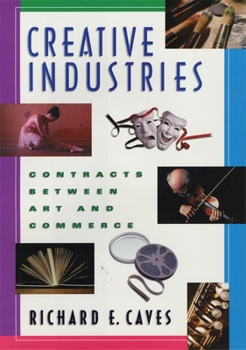
Creative Industries: Contracts Between Art and Commerce

Select Format
Select Condition 
Book Overview
Revised
Format:Paperback
Language:English
ISBN:0674008081
ISBN13:9780674008083
Release Date:April 2002
Publisher:Harvard University Press
Length:464 Pages
Weight:1.15 lbs.
Dimensions:1.2" x 6.3" x 9.2"
Customer Reviews
1 rating
The underlying economic principles for many industries
Published by Thriftbooks.com User , 19 years ago
Dozens of books on entertainment industries come out every year, but only few survive the test of time. This is one of them, and not precisely for the encyclopedic amount of information and references it presents (you can actually get many more references by sending an email to the author), or for its practical value --which in my opinion is high. The value of this book boils down to its elegant treatment of the economic logic behind seemingly unrelated businesses like moviemaking or ballet. The chapter on contracts for creative products is truly illuminating. The author provides upfront the seven basic economic principles that affect all creative industries: 1. Demand is uncertain 2. Creative workers care about their product 3. Some creative products require diverse skills 4. Differentiated products. 5, 6, 7: read them yourself. While everybody in the entertainment world might have their own list, this one is written and carefully developed by Richard Caves. The format might be intimidating to some (e.g., no pictures, no tables, no flashy stuff), so don't buy it if you are not willing to invest a little time and brains to profit from the author's reasoning.
Copyright © 2026 Thriftbooks.com
Terms of Use | Privacy Policy | Do Not Sell/Share My Personal Information | Cookie Notice | Cookie Preferences | Accessibility Statement
ThriftBooks ® and the ThriftBooks ® logo are registered trademarks of Thrift Books Global, LLC
ThriftBooks ® and the ThriftBooks ® logo are registered trademarks of Thrift Books Global, LLC
