
Skip to content
Scan a barcode
Scan
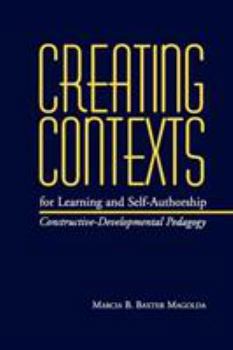
Paperback Creating Contexts for Learning and Self-Authorship: Constructive-Developmental Pedagogy Book

ISBN: 0826513468

ISBN13: 9780826513465

Creating Contexts for Learning and Self-Authorship: Constructive-Developmental Pedagogy

Select Format

Select Condition ThriftBooks Help Icon

Recommended

Format: Paperback

Condition: Very Good

$26.59
Save $13.36!
List Price $39.95
Almost Gone, Only 1 Left!

Book Overview

In her thoughtful and innovative new book, Marcia B. Baxter Magolda writes of "bridging the worlds between educator and students." There is perhaps no task more fundamental to effective teaching and learning. All too often a distinct gap develops or cannot be overcome between instructor and student, one that leaves each struggling to understand the other's position. The professional quest for principles of structure and process that can help close this divide is both evolving and unending.

This book is intended to help college faculty create conditions in which students learn to construct knowledge in their disciplines and achieve self-authorship. A significant, and often overlooked, dimension mediating learning and self-authorship centers on learners' ways of knowing, or their assumptions about the nature, limits, and certainty of knowledge. A learner who assumes that all knowledge is certain expects to hear answers from an authority figure; in contrast, a learner who views knowledge as relative expects to explore multiple viewpoints. By taking a constructive-developmental approach, Baxter Magolda demonstrates how students' ability to construct knowledge is intertwined with the development of their assumptions about knowledge itself and their role in creating it. She shows how the structure of constructive-developmental teaching hinges on three principles: validating students' ability to know, situating learning in students' experience, and defining learning as teachers and students mutually constructing meaning.

Unlike most of the literature on the subject, this book takes abstract pedagogical principles and translates them into practical methods. By observing four semester-length college courses in mathematics, zoology, human development, and education and intensively interviewing students and their instructors, Baxter Magolda provides much-needed, concrete principles that will lead to valuable improvements in the classroom environment. With an enhanced level of understanding of the teaching-learning relationship, professors will be able to teach better, and students will be able to learn better, thus preparing them to meet the demands inherent in adulthood and preparing them to take an active role in creating a better society.

Those actively involved in higher education, whether college faculty or students in graduate programs, as well as anyone focused on education in general will find much of interest in this book.

Customer Reviews

1 rating

Pedagogy that makes a difference in students' lives

Constructive developmental pedagogy, as described by Marcia Baxter Magolda, refers to creating learning contexts in which students are allowed to generate their own ideas and find their own voices. Building on the work of Robert Kegan, Magolda argues that teachers should help students achieve self-authorship, creating individuals who are able to create strong positive relations with others while maintaining their own sense of selfhood. Self authorship is "simultaneously an ability to construct knowledge in a contextual world, an ability to construct an internal identity separate from external influences, and an ability to engage in relationships without losing one's internal identity." Referencing her earlier well-known longitudinal study of college youth, Magolda argues that students have the potential to pass through four ways of knowing, moving from absolute knowing, through transitional-, independent-, and possibly contextual-knowing. (People who know the Perry scheme of intellectual development will recognize this model.) Three of the four modes are gender-related, with men more focused on impersonal knowing and women on connected knowing, but the overall scheme applies to all students.How do teachers achieve the ambitious goal of helping students achieve self authorship? First, Magolda argues that teachers must create conditions within which students are validated as knowers, rather than as passive receptacles into which experts pour knowledge. Second, pedagogical practices must situate learning in students' own experiences, creating new experiences or drawing on their previous experiences, rather than presenting knowledge as detached and free-floating. Third, teachers must collaborate with students in defining learning as mutually constructed meaning. Magolda takes great pains to point out that this does not mean turning students loose in an anything goes environment. Instead, students must be initiated into the community of knowing within a teacher's discipline or field, with teachers modeling good practices for students and helping them experience the thrill of discovering knowledge for themselves.Magolda documents the effectiveness of her model by presenting ethnographic and survey data from her own classes and those of three other instructors at Miami University of Ohio. She does a wonderful job of conveying what it was like to be a student in these classes, and is realistic about the limits of what each instructor achieved. Most courses did well in reaching transitional, independent, and contextual knowers, but fell short with absolute knowers.I highly recommend this book to instructors ready for the challenge of trying to make a real difference in the lives of their students. The book does not shy away from the dilemmas of trying to make this approach work in the face of ingrained assumptions antithetical to its use. Indeed, Magolda identifies and counters the typical false dilemmas thrown against the method by critics, and in
Copyright © 2026 Thriftbooks.com Terms of Use | Privacy Policy | Do Not Sell/Share My Personal Information | Cookie Policy | Cookie Preferences | Accessibility Statement
ThriftBooks® and the ThriftBooks® logo are registered trademarks of Thrift Books Global, LLC

GoDaddy Verified and Secured