


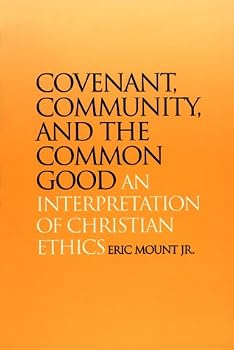
Covenant, Community, and the Common Good: An Interpretation of Christian Ethics

Book by Mount, Eric, Jr. This description may be from another edition of this product.
Format:Paperback
Language:English
ISBN:0829813551
ISBN13:9780829813555
Release Date:January 1999
Publisher:United Church Press
Length:200 Pages
Weight:0.70 lbs.
Dimensions:0.6" x 6.0" x 9.0"
Customer Reviews
1 rating
A much-needed corrective
Published by Thriftbooks.com User , 25 years ago
American society and the associations that constitute it are breaking down. The cultural consensus, if there ever was one, is more in disarray now than every before in history. In order to address the situation, the meaning-makers of our culture have posited a variety of approaches, from the liberal to the communitarian with the revisionist liberals and societal communitarians in between, in search of the one that will provide the return to order for which we all groan. In Covenant, Community, and the Common Good: An Interpretation of Christian Ethics, author and ethicist Eric Mount Jr. surveys and critiques the major positions espoused by various schools of ethics as represented by a wide range of individual thinkers and, picking and choosing judiciously among them, constructs the theological base for what might be called a hybrid model of ethics which he invites the culture to consider--that of community based on covenant and the common good. In the first two chapters Mount looks at the concepts of covenant from the Hebraic heritage and of the common good as put forth by Aristotle, pointing out strengths and shortcomings of each, particularly in their historical manifestations. In chapters three, four and five he seeks to discover a "middle way" which will help us claim and reclaim the positive values of covenant and the common good while correcting the abusive ways in which these organizing principles have been applied. Mount seeks "starting points"(51) in considering the very real issues of various levels and forms of community: the family, the venues of national commerce and politics, and the global community. As a case in point, he considers society's grappling with homosexuality in light of the work of Max Stackhouse and Paula M. Cooey. Each beginning with the same Reformed tradition, Genesis creation story, and covenant as their central norm, Stackhouse develops a thesis which supports the traditional view of homosexuality, while Cooey's thesis critiques the traditional view and elevates difference and relationship over law and order, an approach in which Mount finds greater promise for social consensus. (66-67) For Mount, community involves that which gives each member "a sense of identity connected to a center of loyalty, the sense of responsibility, the respect for diversity, and the openness to participation in decisions."(31) He has done an excellent job in providing examples of ways in which this community can be realized in the workplace, the home, politics, schools, religious institutions, and the multiple other venues and associations. His fundamental approach is dialogical. "(F)acilitating communication and modeling respect for difference, sensitivity to need, and commitment to the values of liberty and justice for all"(154) must be central to the process. In the end, Mount calls for the development of the "civic virtues" of faith, hope, love and gratitude: "faith as openness to the other, love as affirmation of th
Copyright © 2026 Thriftbooks.com
Terms of Use | Privacy Policy | Do Not Sell/Share My Personal Information | Cookie Policy | Cookie Preferences | Accessibility Statement
ThriftBooks ® and the ThriftBooks ® logo are registered trademarks of Thrift Books Global, LLC
ThriftBooks ® and the ThriftBooks ® logo are registered trademarks of Thrift Books Global, LLC
