


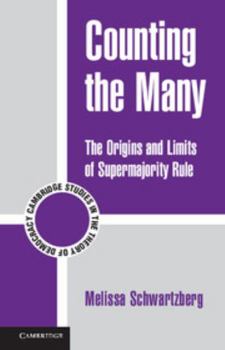
Counting the Many
(Part of the Cambridge Studies in the Theory of Democracy Series)
No Customer Reviews

Select Format
Select Condition 
Book Overview
Supermajority rules govern many features of our lives in common: from the selection of textbooks for our children's schools to residential covenants, from the policy choices of state and federal... This description may be from another edition of this product.
Format:Paperback
Language:English
ISBN:B01EQ3Q0BO
ISBN13:9780521124492
Release Date:November 2013
Publisher:Cambridge University Press
Length:248 Pages
Weight:0.80 lbs.
Dimensions:0.7" x 5.4" x 8.4"
Customer Reviews
0 rating
Copyright © 2026 Thriftbooks.com
Terms of Use | Privacy Policy | Do Not Sell/Share My Personal Information | Cookie Policy | Cookie Preferences | Accessibility Statement
ThriftBooks ® and the ThriftBooks ® logo are registered trademarks of Thrift Books Global, LLC
ThriftBooks ® and the ThriftBooks ® logo are registered trademarks of Thrift Books Global, LLC
