
Skip to content
Scan a barcode
Scan
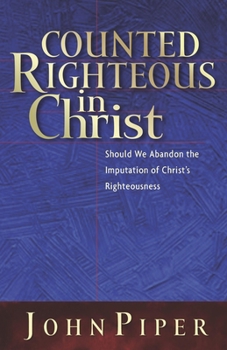
Paperback Counted Righteous in Christ: Should We Abandon the Imputation of Christ's Righteousness? Book

ISBN: 1581344473

ISBN13: 9781581344479

Counted Righteous in Christ: Should We Abandon the Imputation of Christ's Righteousness?

Select Format

Select Condition ThriftBooks Help Icon

Recommended

Format: Paperback

Condition: Very Good

$6.59
Save $11.40!
List Price $17.99
Almost Gone, Only 1 Left!
Save to List

Book Overview

Are Christians merely forgiven, or do they possess the righteousness of Christ? Recently the time-honored understanding of the doctrine of justification has come under attack. Many question how-or if-we receive the full righteousness of Christ.

Martin Luther said that if we understand justification "we are in the clearest light; if we do not know it, we dwell in the densest darkness." And now, in this new and important book, John Piper accepts Luther's challenge. He points out that we need to see ourselves as having been recipients of the imputation of Christ's righteousness and therefore enjoy full acceptance with God and the everlasting inheritance of life and joy.

Piper writes as both a pastor and a scholar. His pastor's heart is shown in his zeal for the welfare of the church. His careful scholarship is evident in each explanation and undergirds each conclusion.

Customer Reviews

5 ratings

Effectively Plugs the Leak on Justification

John Piper is among the most respected American pastors of our day, in part because he comprehensively integrates pastoral theology with biblical and systematic theology in a way that produces a full-orbed Christian perspective and grounding. In this book, Piper focuses on the imputation of righteousness that is central to the Protestant doctrine of justification by faith alone. Many giants of the faith regard the doctrine of justification as a showstopper doctrine, essential to a right understanding of Christianity. As such, it is no surprise that similar to other essential tenets of the faith such as the Trinity, the resurrection, and the inspiration and authority of Scripture, the doctrine of justification is a stumbling block for many that has resulted in various forms of retreat.The latest retreat comes at the hands of Robert Gundry, who attempts to argue that the imputation of Christ's righteousness to the believer as a result of faith is unbiblical. He argues instead that the inherent faith of the believer is what is counted as righteous in the act of justification, rather than a transfer of Christ's righteousness to us through faith. While this might seem a nuanced difference, in reality, it goes straight to the core of what it means to be justified. Gundry's view in a number of respects is much closer to Roman Catholicism's irresponsible mixing of justification and sanctification in ways that render many sections of Scripture unintelligible. Gundry believes that the act of justification (of our inherent faith) defeats the mastery of sin over our lives (which is traditionally the separate work of sanctification), rather than a legal transfer of Christ's righteousness to us as the basis for justification and the sole grounding for subsequent sanctification. Gundry's view represents a basic retreat on the doctrine of justification, a retreat that at its core resembles all other retreats in elevating the inherent abilities of man and taking away from the work of God by wholly underestimating the pervasive nature of human sin and overestimating man's inherent abilities.It is this position that Piper interacts with in this book. Chapter 3 of the book is clearly the most crucial, since this is where he offers an exegetical critique of Gundry and in the process, validates the imputation of Christ's righteousness to the believer that is central to justification. Piper's examination of Romans 1-6 in particular is outstanding, along with 2 Corinthians 5. He builds a logical, step by step case that reveals how Gundry's position is untenable, and provides believers with a great deal of reassurance that Christ's imputed righteousness, rather than their sin-tainted acts, is the basis of our right standing with God.I will note some minor quibbles with the book that deserve mention but do not significantly detract from the outstanding presentation given by Piper. First, there are times when Piper tends to devote too much ink to peripheral poi

Solid Defense of Imputed Righteousness

John Piper is hard NOT to respect. He is among a handful of solid theologians who makes the effort to address the challenges to the evangelical faith (from within) with grace, clarity, and sincerity.In this work, Piper defends the traditional evangelical understanding of imputed righteousness, i.e., that when a person trusts Christ, he not only has his sins forgiven but is, on the positive side, given the righteousness of Christ. This concept, imputed righteousness, is currently being challenged from within evangelicalism.Piper quotes the leading proponent of this view, Dr. Robert Gundry, explains Gundry's perspective, and contrasts it to the traditional one. He then explores the relevant Scriptures and demonstrates why Gundry is wrong. He attempts to lead the reader to conclude that the Scriptures do in fact teach that we are counted as righteous once we are in Christ. We exchange our sin for His righteousness.Piper is not really much of a salesman. Although his language is clear and his sincerity obvious, it is the strength of the Scriptures themselves that do the convincing. And that is not bad! I highly recommend this work. The serious laymen can understand this volume, but it is not "pop Christian" by any means, but requires the reader to think. And that's not bad, either!As we see more and more challenges either directly toward the heart of the Gospel or the periphery, it is great to have Piper on our side! Here is my favorite quotation from this brief volume. The argument is that if Paul had taught Gundry's view in Romans 1-5, the questions of chapter 6 would never have arisen (this is more formidable than meets the eye; if our version of the Gospel does not result in these questions, we may be preaching the wrong message!):"The doctrine of justification by faith apart from works raises the question, 'Are we to continue in sin that grace may increase?...And shall we sin because we are not under law but under grace?' The raising of these questions is a powerful indication that justification does not include liberation from the mastery of sin. For if it did, these questions would not plausibly arrive..." Good stuff!

Couldn't Put it Down!

This book caught my eye and kept me enthralled! I will certainly read it again and have already recommended it to friends who are serious about their faith. The book awakened me to the real threat of compromising on this crucial issue. Piper writes with heart while maintaining intellectual integrity. This work is a must read for pastors, missionaries, counselors and disciple-makers who continually deal with pressure to compromise the uncompromisable in the name of contextualization. A gospel without imputation is no real gospel at all, and as Piper makes so clear, the idea is antithetical to scripture!Enjoy the read!

The Compassion of a Shepherd, the Competence of a Scholar

What a wonderful book this is, combining pastoral warmth with exegetical precision in the defense and confirmation of the very heart of the Christian gospel: justification by faith alone. Piper shows that sinners are made right with God through the righteousness of Christ which is credited to them. That this is being challenged to me today is mind-boggling. Why do people want to destroy such good news? Why wrestle against what is so lucid and clear and Scriptural? Well, the threats are there and John Piper has faced them. Chapter one describes the many personal reasons in family, church, culture, and the nations why this issue is so important. Chapters two and three set out the challenge to this doctrine and defend the truth exegetically. Piper is polite to his opponent (Robert Gundry) and honest with his arguments. There is no mispresentation. This is an excellent book. The Discerning Reader named this book of the year. Thanks to Pastor John for writing it and thanks to Crossway for publishing it.

Exult in the centrality of Christ in our salvation!

Just as the title doesn't mince words, this book presents a clear and concise examination of the issue at stake: the historic protestant doctine of the imputation of Christ's righteousness, and with that, the very issue of justification itself. This is a timely response to the controversy and growing defection from the doctrine in evangelical and reformed circles. In the first chapter, Piper spells out his motivation for the book: the theological and practical implications of the doctrine. The second chapter carefully defines the specifics of the question at stake. The third chapter contains the exegetical arguments, and the forth concludes the book.Piper writes with passion and with a pastor's heart. With that, I am struck all the more by how careful and even-toned his exegesis is, when so many passionate arguments are little more than polemics consisting of slogans and unexplained proof-texts. Piper uses no such rhetoric, remaining respectful to his theological opponents, even acknowledging how certain texts could, by the letter, fit their position. But Piper builds a solid case that the righteousness of the elect is that of Christ, not by force-fitting proof texts into a pre-conceived systematic, but by a level-headed consideration of the context and the flow of the text.Though short, this book is not always light reading. Many of the arguments require a great deal of chewing on. It probably has to do with Piper trying to provide as much clarity as possible. This is a welcome contrast to much of the opposing literature which uses familiar terminology in vague statements that end up lulling the reader into feeling good about what was said, rather than rigorously thinking about and understanding it (and how it might deviate from the historic position).There was a time when I did not think the doctine of imputed righteousness to be of much importance. For those who find themselves in that position, I cannot recommend this book enough. It is a wonderful thing that Christ is truly our all in all, our righteousness as well as our penal substitute; that our standing before God is secure in our union with Christ in heaven and not in a performance that we have to pull off. Indeed, it is the obedience of Christ, active and the passive, that provides the firm foundation of our salvation. No hope without it.
Copyright © 2026 Thriftbooks.com Terms of Use | Privacy Policy | Do Not Sell/Share My Personal Information | Cookie Policy | Cookie Preferences | Accessibility Statement
ThriftBooks® and the ThriftBooks® logo are registered trademarks of Thrift Books Global, LLC

GoDaddy Verified and Secured