


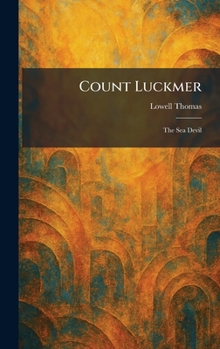
Count Luckmer: The Sea Devil

"Count Luckmer, The Sea Devil" is a thrilling historical narrative that captures the adventurous life of one of the Great War's most unconventional heroes. This work documents the remarkable career of the German naval officer who famously operated the SMS "Seeadler", a wind-powered vessel used as a commerce raider. At a time when steel and steam dominated the seas, the "Sea Devil" relied on sails and cunning to outmaneuver Allied naval forces across the Atlantic and Pacific oceans.
The book details how this figure managed to capture numerous ships while maintaining a reputation for gallantry and humanity, frequently avoiding casualties among his prisoners. Through Lowell Thomas's vivid storytelling, the reader is transported into a world of maritime strategy and daring escapes. "Count Luckmer, The Sea Devil" stands as a significant historical document of World War I, offering a romanticized yet informative look at naval combat and the vanishing era of great sailing ships. It remains an essential read for those interested in military biography, naval history, and the enduring allure of high-seas adventure.
This work has been selected by scholars as being culturally important, and is part of the knowledge base of civilization as we know it. This work was reproduced from the original artifact, and remains as true to the original work as possible. Therefore, you may see the original copyright references, library stamps (as most of these works have been housed in our most important libraries around the world), and other notations in the work.
This work is in the public domain in the United States of America, and possibly other nations. Within the United States, you may freely copy and distribute this work, as no entity (individual or corporate) has a copyright on the body of the work.
As a reproduction of a historical artifact, this work may contain missing or blurred pages, poor pictures, errant marks, etc. Scholars believe, and we concur, that this work is important enough to be preserved, reproduced, and made generally available to the public. We appreciate your support of the preservation process, and thank you for being an important part of keeping this knowledge alive and relevant.
Customer Reviews
ThriftBooks ® and the ThriftBooks ® logo are registered trademarks of Thrift Books Global, LLC
