


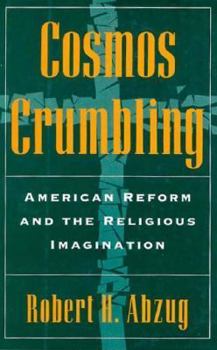
Cosmos Crumbling: American Reform and the Religious Imagination

Select Format
Select Condition 
Book Overview
In the forty years before the Civil War, America was awash in political and social reform movements. Abolitionists stormed against the cruelties of slavery. Temperance zealots hounded producers and consumers of strong drink. Sabbatarians fought to make Sunday an officially recognized sacred day. Woman's rights activists proclaimed the case for sexual equality. Others offered programs of physiological and spiritual self-reform: phrenology, vegetarianism, the water-cure, spiritualism, and miscellaneous others. "Even the insect world was to be defended," Emerson mused, "and a society for the protection of ground-worms, slugs, and mosquitoes was to be incorporated without delay."
Cosmos Crumbling brilliantly reassesses the religious roots of these antebellum reform movements through a series of penetrating profiles of key men and women who sought to remake their worlds in sacred terms. Filled with vivid anecdotes and penetrating analysis, the book presents a genealogy of reform cosmology that begins with the American Revolution and ends with "the woman question," the issue that drove a wedge between traditional evangelical reformers and the more radical reformers who questioned the very foundations of the conventional Christian cosmos. Here is the story of Declaration of Independence signer Benjamin Rush, and his lifelong odyssey to bring together his unorthodox Christian ideals and his revolutionary republicanism. Other portraits highlight the guiding role of religion in the careers of the tireless abolitionist William Lloyd Garrison, the evangelical minister Lyman Beecher, his daughter, influential educational reformer Catharine Beecher, and of Angelina and Sarah Grimk , and Lydia Maria Child, fearless women who made enormous strides in reimagining the spiritual and moral power of women and their place in society. There is also an intriguing chapter on leaders of the body reforms, including phrenologist Orson Squire Fowler, who began his career reading the heads of his fellow students at Amherst College for small change, and William Andrus Alcott, who advocated a bland vegetarian diet, cold water bathing, and a profusion of daily rituals to guide his followers through their every waking moment.
Arguing that we cannot understand American reform movements unless we understand the sacred significance reformers bestowed on the worldly arenas of politics, society, and the economy, Abzug presents these men and women in their own words, placing their cherished ideals and their often heated squabbles within the context of their millennial and sometimes apocalyptic sense of America's role in the cosmic drama. Tracing the lasting impact of what began as a peculiarly Protestant, largely New England, style of social action on the uniquely American traditions of activism that flourish today, Cosmos Crumbling is a signal contribution to our understanding of the myriad ways in which the quest for enlightenment and salvation continues to shape American politics.
Cosmos Crumbling brilliantly reassesses the religious roots of these antebellum reform movements through a series of penetrating profiles of key men and women who sought to remake their worlds in sacred terms. Filled with vivid anecdotes and penetrating analysis, the book presents a genealogy of reform cosmology that begins with the American Revolution and ends with "the woman question," the issue that drove a wedge between traditional evangelical reformers and the more radical reformers who questioned the very foundations of the conventional Christian cosmos. Here is the story of Declaration of Independence signer Benjamin Rush, and his lifelong odyssey to bring together his unorthodox Christian ideals and his revolutionary republicanism. Other portraits highlight the guiding role of religion in the careers of the tireless abolitionist William Lloyd Garrison, the evangelical minister Lyman Beecher, his daughter, influential educational reformer Catharine Beecher, and of Angelina and Sarah Grimk , and Lydia Maria Child, fearless women who made enormous strides in reimagining the spiritual and moral power of women and their place in society. There is also an intriguing chapter on leaders of the body reforms, including phrenologist Orson Squire Fowler, who began his career reading the heads of his fellow students at Amherst College for small change, and William Andrus Alcott, who advocated a bland vegetarian diet, cold water bathing, and a profusion of daily rituals to guide his followers through their every waking moment.
Arguing that we cannot understand American reform movements unless we understand the sacred significance reformers bestowed on the worldly arenas of politics, society, and the economy, Abzug presents these men and women in their own words, placing their cherished ideals and their often heated squabbles within the context of their millennial and sometimes apocalyptic sense of America's role in the cosmic drama. Tracing the lasting impact of what began as a peculiarly Protestant, largely New England, style of social action on the uniquely American traditions of activism that flourish today, Cosmos Crumbling is a signal contribution to our understanding of the myriad ways in which the quest for enlightenment and salvation continues to shape American politics.
Format:Hardcover
Language:English
ISBN:0195037529
ISBN13:9780195037524
Release Date:April 1994
Publisher:Oxford University Press, Incorporated
Length:304 Pages
Weight:1.35 lbs.
Dimensions:9.5" x 1.3" x 6.3"
Related Subjects
Biographical Biographies Biographies & History Biography & History Christian Books & Bibles Christianity Church History History Humanities Linguistics Modern (16th-21st Centuries) Philosophy Political History Political Science Politics & Government Politics & Social Sciences Public Policy Religion Religion & Spirituality Religious Studies Social Science Social Sciences Textbooks Words, Language & GrammarCustomer Reviews
1 rating
Excellent.
Published by Thriftbooks.com User , 27 years ago
Robert Abzug's fresh approach to antebellum reform illuminates some of its underlying causes. Abzug explores the antebellum religious imagination, positing that the reformers set about "sacralizing the world"--radically joining Heaven and Earth. In antebellum America, the language of religion, politics and science all reinforced each other. Abzug argues that Lyman Beecher confronted the crisis in New England identity by transferring its spiritual identity as a spiritual Israel to all of America. This sense of mission then drove the evangelical program of reform. Likewise, William Lloyd Garrison re-imagined the basis of American society by advocating a radical egalitarianism--blacks were entitled to all rights of citizenship. Abzug argues that all reforms sprung from the wellspring of religious imagination. Reformers were rethinking church and society. Inspired by their visions, they set out to remake America. Abzug is convincing. My one main criticism is that Abzug did not set American reform in its larger context. Many American reformers were indebted to their European counterparts. What of the European religious imagination? How was it different from the American? Nonetheless, this shortcoming is small given Abzug's deep insight into American reform. I highly recommend this work to students of antebellum reform or American religion.
Copyright © 2026 Thriftbooks.com
Terms of Use | Privacy Policy | Do Not Sell/Share My Personal Information | Cookie Policy | Cookie Preferences | Accessibility Statement
ThriftBooks ® and the ThriftBooks ® logo are registered trademarks of Thrift Books Global, LLC
ThriftBooks ® and the ThriftBooks ® logo are registered trademarks of Thrift Books Global, LLC
