


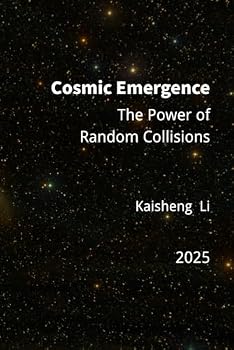
Cosmic Emergence: The Power of Random Collisions
No Customer Reviews

The objective of this book is to construct a universal theoretical framework for random collisions, revealing their role as the core non-autonomous mechanism of cosmic evolution, applicable across phenomena from subatomic to cosmic scales. The theory extends beyond explaining the formation of physical systems (e.g., galaxies, stars) to chemical complexity (e.g., organic molecule aggregation), the origin of life (e.g., self-catalytic networks), and the evolution of complex systems (e.g., social networks, ecosystems). By integrating multidisciplinary theoretical tools and empirical data, the book aims to address the following key questions: - How do random collisions drive the transition from disorder to order through probabilistic accumulation? - What are the commonalities and differences in the manifestations of random collisions across different scales (quantum, molecular, macroscopic)? - Can random collisions serve as a unified mechanism for complex system evolution, surpassing the limitations of traditional self-organization theories? To achieve this, the book proposes validation pathways, including: - **Astronomical Observations**: Using data from cosmic background radiation, galaxy distributions, and gravitational waves to verify the role of random collisions in large-scale structure formation. - **Laboratory Simulations**: Conducting molecular dynamics experiments and particle accelerator studies to simulate random collision processes at microscopic scales. - **Computational Modeling**: Developing Monte Carlo methods and N-body simulations to predict the long-term evolutionary outcomes of random collisions. The book is divided into five parts, structured as follows: Part I: Foundations of Random Collision Theory (Chapters 3-5): Elucidates the essence, conditions, and mechanisms of diversity generation in random collisions, establishing the physical and mathematical foundations of the theory. Part II: Evolutionary Processes of Random Collisions (Chapters 6-8): Analyzes the evolutionary stages driven by random collisions, from microscopic particles to the increasing complexity of macroscopic structures. Part III: Applications of Random Collision Theory (Chapters 9-11): Explores the specific applications of random collisions in galaxy formation, the origin of life, and the evolution of complex systems. Part IV: Speculations on the Initial State of the Universe (Chapters 12-14): Hypothesizes the characteristics and conditions of the universe's initial state, analyzing how random collisions set the possibilities for evolution. Part V: Significance and Prospects of the Theory (Chapters 15-17): Discusses the philosophical implications, scientific validation pathways, and future research directions of random collision theory. Additionally, appendices include a glossary, references, and an index to facilitate in-depth study. The book progresses logically from microscopic mechanisms to macroscopic applications and philosophical reflections, aiming to provide a unified theoretical perspective for interdisciplinary researchers.
Format:Paperback
Language:English
ISBN:B0F626RNB9
ISBN13:9798280972117
Release Date:April 2025
Publisher:Independently published
Length:241 Pages
Dimensions:9.0" x 0.6" x 6.0"
Customer Reviews
0 rating
Copyright © 2026 Thriftbooks.com
Terms of Use | Privacy Policy | Do Not Sell/Share My Personal Information | Cookie Policy | Cookie Preferences | Accessibility Statement
ThriftBooks ® and the ThriftBooks ® logo are registered trademarks of Thrift Books Global, LLC
ThriftBooks ® and the ThriftBooks ® logo are registered trademarks of Thrift Books Global, LLC
