


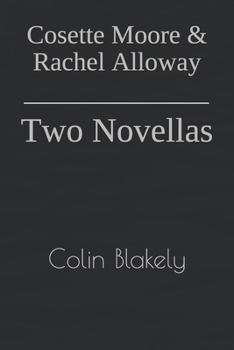
Cosette Moore & Rachel Alloway: Two Novellas
No Customer Reviews

To The Reader, There are a few things I need to share with you about these dark comedies, for my own sake, to assuage my fear of Cosette Moore being misinterpreted or of Rachel Alloway inadvertently rousing the baser impulses of fanatics. (The latter is highly unlikely but not impossible. I've heard far-right figures quote, and emulate, the new left.) Fortunately, I can think of no reason why I'd have to do this at length. If I do it well, I won't have to do it for long.Everything I've ever written to this point has expressed, to varying degrees, my unwavering contempt for demagogy, dogmatism, inequity or outright totalitarianism. The apertures in our societies-the political dormancy, the shortcomings in our education systems, the naivet of our online pseudo-intelligentsias, the reach of our deluded conspiracy theorists, aggrieved bigots, censorious fundamentalists and myopic tabloids-have, in some sense, always been there. They emit a stench that invites megalomania, which inverts representation bit by bit and edges us closer to a society where the voters represent the elected.Cosette Moore focuses on the apertures. There's inescapable discontent, cynicism and gnawing frustration with the day-to-day on almost every page. Cosette introduces what she calls "equivocis" which is, frankly, a way of mocking those who use terms like "liberal" or "conservative" or "socialist" without really knowing what those terms mean. While not crucial to the story, this lays the foundation for Rachel Alloway, which focuses on megalomania and deserves more of an explanation. It's difficult to write as a narrator with no knack for storytelling. It's especially difficult when duplicity is at the heart of the story and almost every character is pretending to be something they're not. Rachel Alloway puts the political spectrum to the side-when it doesn't, the spectrum is always being invoked erroneously-in order to examine the theocratic nature of budding totalitarianism. "Forget everything you know," after all, is always the first command. And too often it seems as if we don't require the command at all, as if we're forgetting everything we know regardless of whether or not we're being told to.Exploiting the apertures, making distinctions without differences, whittling the fourth estate, establishing some orwellian memory hole, utilizing obscurity, duplicity, high-sounding rhetoric-all are of the essense if you're planning on convincing people to believe in something that defies reason.Readers awaiting the second command will be disappointed. The entire book takes place in the prolonged era of ascensions that follows "forget everything you know". Regarding style, I need only address one aspect: Rachel's internal monologues. These brief episodes are a nod to what was an exhausted style thirty years ago-a style that is now dead and buried. Long, dense, verbose stream-of-consciousness episodes are gone. Let them rest, pay your respects, but you'd have better luck (and more originality) dressing like Elvis than you'd have writing the next Mrs Dalloway.To include an extensive list of people I'd like to thank or acknowledge as an inspiration would be foolish and, at this stage, shameless self-aggrandizement. If the following books are neither funny nor thought-provoking than I hope they're at least intelligible. If they are none of these than I've fallen well short and done two inexcusable disservices to writing, for which I beg your pardon.-Colin Blakely
Format:Paperback
Language:English
ISBN:B08NV3DH4V
ISBN13:9798567892831
Release Date:November 2020
Publisher:Independently Published
Length:266 Pages
Weight:0.79 lbs.
Dimensions:0.6" x 6.0" x 9.0"
Customer Reviews
0 rating
Copyright © 2026 Thriftbooks.com Terms of Use
| Privacy Policy | Do Not
Sell/Share My Personal Information | Cookie Policy | Cookie Preferences | Accessibility Statement
ThriftBooks® and the ThriftBooks® logo are registered trademarks of Thrift Books Global, LLC
ThriftBooks® and the ThriftBooks® logo are registered trademarks of Thrift Books Global, LLC
