
Skip to content
Scan a barcode
Scan
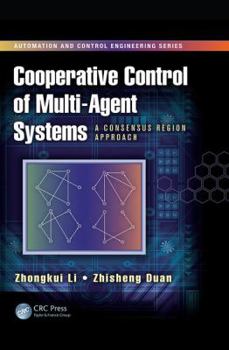
Hardcover Cooperative Control of Multi-Agent Systems: A Consensus Region Approach Book

ISBN: 1466569948

ISBN13: 9781466569942

Cooperative Control of Multi-Agent Systems: A Consensus Region Approach

Select Format

Select Condition ThriftBooks Help Icon

Recommended

Format: Hardcover

Condition: New

$270.00
50 Available
Ships within 2-3 days

Book Overview

Distributed controller design is generally a challenging task, especially for multi-agent systems with complex dynamics, due to the interconnected effect of the agent dynamics, the interaction graph among agents, and the cooperative control laws. Cooperative Control of Multi-Agent Systems: A Consensus Region Approach offers a systematic framework for designing distributed controllers for multi-agent systems with general linear agent dynamics, linear agent dynamics with uncertainties, and Lipschitz nonlinear agent dynamics.

Beginning with an introduction to cooperative control and graph theory, this monograph:

Explores the consensus control problem for continuous-time and discrete-time linear multi-agent systems Studies the H∞ and H2 consensus problems for linear multi-agent systems subject to external disturbances Designs distributed adaptive consensus protocols for continuous-time linear multi-agent systems Considers the distributed tracking control problem for linear multi-agent systems with a leader of nonzero control input Examines the distributed containment control problem for the case with multiple leaders Covers the robust cooperative control problem for multi-agent systems with linear nominal agent dynamics subject to heterogeneous matching uncertainties Discusses the global consensus problem for Lipschitz nonlinear multi-agent systems

Cooperative Control of Multi-Agent Systems: A Consensus Region Approach provides a novel approach to designing distributed cooperative protocols for multi-agent systems with complex dynamics. The proposed consensus region decouples the design of the feedback gain matrices of the cooperative protocols from the communication graph and serves as a measure for the robustness of the protocols to variations of the communication graph. By exploiting the decoupling feature, adaptive cooperative protocols are presented that can be designed and implemented in a fully distributed fashion.

Customer Reviews

0 rating
Copyright © 2025 Thriftbooks.com Terms of Use | Privacy Policy | Do Not Sell/Share My Personal Information | Cookie Policy | Cookie Preferences | Accessibility Statement
ThriftBooks ® and the ThriftBooks ® logo are registered trademarks of Thrift Books Global, LLC

GoDaddy Verified and Secured
