


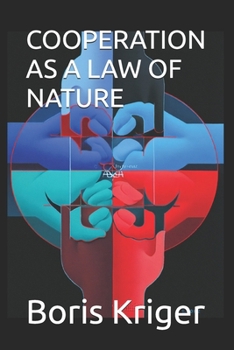
Cooperation as a Law of Nature
No Customer Reviews

Why do people help each other when nobody makes them? Why does a group of homeless strangers, addicts, and outcasts-left in a house in the forest with no rules, no schedules, and no authority-quietly organize themselves into a functioning community? And why does that community often work better than the ones designed by experts?
In Cooperation as a Law of Nature, Boris Kriger traces a single explosive idea from the Siberian wilderness of the nineteenth century to the frontiers of modern science: mutual aid is not a moral achievement. It is a dynamical default-what remains when you stop interfering. Drawing on Peter Kropotkin's revolutionary biology, contemporary neurochemistry, network theory, information science, and nine years of running a shelter where the only rule was "no one tells anyone what to do," Kriger constructs a case that cooperation is not fragile, not idealistic, and not optional. It is the way complex systems naturally behave when external perturbation is removed.
This book reframes the oldest political question-can people govern themselves?-as an engineering problem with a surprising answer. It shows that the real mystery is not why people cooperate but what keeps breaking their cooperation.
Keywords: cooperation, mutual aid, self-organization, Kropotkin, anarchism, complex systems, decentralized governance
In Cooperation as a Law of Nature, Boris Kriger traces a single explosive idea from the Siberian wilderness of the nineteenth century to the frontiers of modern science: mutual aid is not a moral achievement. It is a dynamical default-what remains when you stop interfering. Drawing on Peter Kropotkin's revolutionary biology, contemporary neurochemistry, network theory, information science, and nine years of running a shelter where the only rule was "no one tells anyone what to do," Kriger constructs a case that cooperation is not fragile, not idealistic, and not optional. It is the way complex systems naturally behave when external perturbation is removed.
This book reframes the oldest political question-can people govern themselves?-as an engineering problem with a surprising answer. It shows that the real mystery is not why people cooperate but what keeps breaking their cooperation.
Keywords: cooperation, mutual aid, self-organization, Kropotkin, anarchism, complex systems, decentralized governance
Format:Paperback
Language:English
ISBN:B0GXBW27MB
ISBN13:9798257472381
Release Date:April 2026
Publisher:Independently Published
Length:238 Pages
Weight:0.71 lbs.
Dimensions:0.5" x 6.0" x 9.0"
Customer Reviews
0 rating
Copyright © 2026 Thriftbooks.com
Terms of Use | Privacy Policy | Do Not Sell/Share My Personal Information | Cookie Policy | Cookie Preferences | Accessibility Statement
ThriftBooks ® and the ThriftBooks ® logo are registered trademarks of Thrift Books Global, LLC
ThriftBooks ® and the ThriftBooks ® logo are registered trademarks of Thrift Books Global, LLC
