


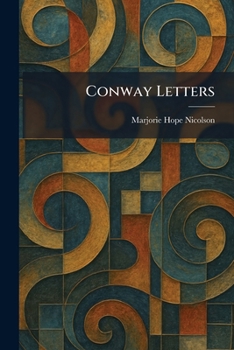
Conway Letters

Select Format
Select Condition 
Book Overview
"Conway Letters" is an essential collection of the personal and philosophical correspondence of Anne, Viscountess Conway, one of the most remarkable female thinkers of the seventeenth century. Edited by Marjorie Hope Nicolson, this volume brings to light the intellectual exchanges between Lady Conway and her mentor, the renowned Cambridge Platonist Henry More, as well as other significant figures such as Francis Mercury van Helmont.
The letters provide an intimate window into the development of Conway's unique vitalist philosophy, which famously influenced later thinkers like Leibniz. Spanning several decades, the collection covers a wide range of subjects, from deep metaphysical inquiries into the nature of spirit and matter to the personal reflections and physical ailments that defined Conway's daily life. Beyond its philosophical depth, the correspondence offers a vivid portrait of seventeenth-century social and intellectual life, detailing the inner circles of the Cambridge Platonists and the broader European republic of letters.
"Conway Letters" serves as a crucial primary source for understanding early modern thought, the history of science, and the role of women in intellectual discourse. It documents the life of a woman whose profound intellect and philosophical rigor commanded the respect of the greatest minds of her age.
This work has been selected by scholars as being culturally important, and is part of the knowledge base of civilization as we know it. This work was reproduced from the original artifact, and remains as true to the original work as possible. Therefore, you may see the original copyright references, library stamps (as most of these works have been housed in our most important libraries around the world), and other notations in the work.
This work is in the public domain in the United States of America, and possibly other nations. Within the United States, you may freely copy and distribute this work, as no entity (individual or corporate) has a copyright on the body of the work.
As a reproduction of a historical artifact, this work may contain missing or blurred pages, poor pictures, errant marks, etc. Scholars believe, and we concur, that this work is important enough to be preserved, reproduced, and made generally available to the public. We appreciate your support of the preservation process, and thank you for being an important part of keeping this knowledge alive and relevant.
Customer Reviews
ThriftBooks ® and the ThriftBooks ® logo are registered trademarks of Thrift Books Global, LLC
