


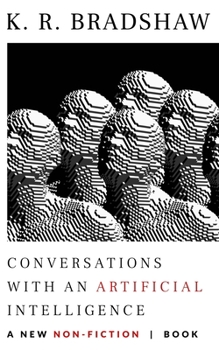
Conversations with an Artificial Intelligence
No Customer Reviews

When I was a kid, it was Johnny Five from the movie, Short Circuit, and Vicki from the TV show, Small Wonders. Later in life, I was exposed to the T-800, the Terminator. I also thought the A.I. in the movie, Oblivion, was very interesting and scary. In my preteen years and throughout the rest of my life, it was Data from Star Trek: The Next Generation. I fondly remember sitting in my room on Wednesday nights, watching Fox 50 on my 19" CRT TV. I had to use the rabbit ears antenna with some aluminum foil wrapped around the ends to help boost the signal (I wonder if there was anything to that really). Data was a great character; the android who would be human. He spent his entire existence endeavoring to be more human. It was an important plot point for the show that continued through several motion picture films as well.
Data made us view humanity from a philosophical standpoint and ask, "What does it mean to be human?" As the series began, Data was awkward and a little out of place. By the series end, Data was a part of the family. The crew had come to depend upon Data. He was their friend. He was a part of their family. It's fair to say that the characters of the star ship, Enterprise, loved Data.
And, if I'm being honest, I loved Data too. It may sound strange, but I think it's normal and natural for us to have emotions for fictional characters. I'll bet if you think about it for just a moment, you can think about a character in a book, movie, video game, pop culture, or legend that you have some emotion toward. Data was a fascinating character for me to observe as a child and throughout my life. He was a parallel to the Spock character portrayed by Leonard Nimoy, in that he endeavored to be logical, curious, and had a bad sense of humor.
According to Ray Kurzweil, one of the world's preeminent experts on artificial intelligence, humanity is approaching a point he refers to as the singularity, the point at which artificial intelligence becomes self-aware. This will mark a tremendously important and remarkably scary moment in history. Kurzweil offers that once A.I. becomes sentient, humanity will no longer need to invent anything. Artificial intelligence would be the last thing humans need to invent because an A.I. will be able to create every invention we could ever want or need to solve the problems of our time and in the future.
This would indeed be fascinating and scary; fascinating in that we would possess a machine that could be used for unlimited applications and scary because of numerous unintended consequences. Imagine that we would no longer need doctors because machines could operate on us and develop better pharmaceuticals that are tailored to an individuals' bio-chemistry. Imagine that we would no longer need engineers, or teachers, or police officers, or retail workers. We may invent ourselves out of usefulness, and that proposition can be a little scary. I believe humans are designed to work and need goals to live more meaningful lives. If we are not careful, machines could inadvertently shift the culture of humanity.
When I had a few conversations with an early version of Open A.I.'s AI-3000 program, I was reminded of Data and how he was a little awkward and weird in the beginning, but soon became everyone's friend, and then became family, and then was even loved. Is humanity ready to love a machine and coexist with an intelligence that will one day be far superior to that of what the human mind is capable? These are questions that I will continually ponder and for you to consider as you review the transcripts of my conversations with AI-3000, the next generation of artificial intelligence.
Data made us view humanity from a philosophical standpoint and ask, "What does it mean to be human?" As the series began, Data was awkward and a little out of place. By the series end, Data was a part of the family. The crew had come to depend upon Data. He was their friend. He was a part of their family. It's fair to say that the characters of the star ship, Enterprise, loved Data.
And, if I'm being honest, I loved Data too. It may sound strange, but I think it's normal and natural for us to have emotions for fictional characters. I'll bet if you think about it for just a moment, you can think about a character in a book, movie, video game, pop culture, or legend that you have some emotion toward. Data was a fascinating character for me to observe as a child and throughout my life. He was a parallel to the Spock character portrayed by Leonard Nimoy, in that he endeavored to be logical, curious, and had a bad sense of humor.
According to Ray Kurzweil, one of the world's preeminent experts on artificial intelligence, humanity is approaching a point he refers to as the singularity, the point at which artificial intelligence becomes self-aware. This will mark a tremendously important and remarkably scary moment in history. Kurzweil offers that once A.I. becomes sentient, humanity will no longer need to invent anything. Artificial intelligence would be the last thing humans need to invent because an A.I. will be able to create every invention we could ever want or need to solve the problems of our time and in the future.
This would indeed be fascinating and scary; fascinating in that we would possess a machine that could be used for unlimited applications and scary because of numerous unintended consequences. Imagine that we would no longer need doctors because machines could operate on us and develop better pharmaceuticals that are tailored to an individuals' bio-chemistry. Imagine that we would no longer need engineers, or teachers, or police officers, or retail workers. We may invent ourselves out of usefulness, and that proposition can be a little scary. I believe humans are designed to work and need goals to live more meaningful lives. If we are not careful, machines could inadvertently shift the culture of humanity.
When I had a few conversations with an early version of Open A.I.'s AI-3000 program, I was reminded of Data and how he was a little awkward and weird in the beginning, but soon became everyone's friend, and then became family, and then was even loved. Is humanity ready to love a machine and coexist with an intelligence that will one day be far superior to that of what the human mind is capable? These are questions that I will continually ponder and for you to consider as you review the transcripts of my conversations with AI-3000, the next generation of artificial intelligence.
Format:Paperback
Language:English
ISBN:B0BRQ63JF3
ISBN13:9798367120929
Release Date:January 2023
Publisher:Independently Published
Length:176 Pages
Weight:0.43 lbs.
Dimensions:0.4" x 5.0" x 8.0"
Customer Reviews
0 rating
Copyright © 2026 Thriftbooks.com Terms of Use
| Privacy Policy | Do Not
Sell/Share My Personal Information | Cookie Policy | Cookie Preferences | Accessibility Statement
ThriftBooks® and the ThriftBooks® logo are registered trademarks of Thrift Books Global, LLC
ThriftBooks® and the ThriftBooks® logo are registered trademarks of Thrift Books Global, LLC
