


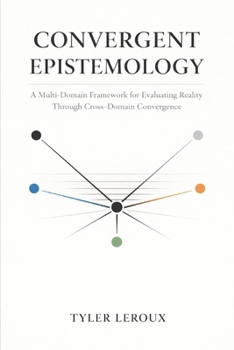
Convergent Epistemology: A Multi-Domain Framework for Evaluating Reality Through Cross-Domain Convergence

What if the way we evaluate truth is fundamentally incomplete?
Most discussions about reality are conducted within isolated domains-science, history, philosophy, or human experience-each treated as a self-contained field of inquiry. Arguments are developed and defended within these domains, but there is no consistent method for integrating them into a unified evaluation.
As a result, systems are often assessed selectively rather than comprehensively.
Convergent Epistemology introduces a different approach.
Instead of evaluating arguments in isolation, it proposes that systems should be assessed based on how well they maintain alignment across multiple independent domains of reality at the same time.
At the center of this work is the Worldview Evaluation Protocol (WEP)-a structured, multi-domain framework designed to measure cross-domain convergence.
Rather than asking:
"Which argument is strongest?"
It asks:
"Which system holds together across the full range of reality simultaneously?"
The framework evaluates systems across five domains:
Predictive capacity
Anomalous data
Knowledge production
Macro-historical impact
Experiential coherence
Each domain is assessed independently. The key insight emerges when these evaluations are considered together.
When multiple domains align under a single explanatory framework, interpretive flexibility begins to collapse. Systems can no longer be explained away one domain at a time. This pattern-referred to as convergence-becomes the central object of analysis.
As convergence increases, the space of plausible alternatives decreases.
In addition to its evaluative function, the framework introduces a structural interpretation layer. This layer explores whether convergence across domains reflects deeper constraints on admissibility, inference, and observation-shifting the focus from isolated agreement to the conditions that make such alignment possible.
This work also clarifies the role of domain independence through the concept of functional distinctness. Domains are not assumed to be fully independent, but sufficiently distinct in their methods and evaluative criteria such that convergence across them remains non-trivial.
Included in this work:
A defined multi-domain evaluation structure
A formal convergence function
A structural interpretation layer
Clarification of domain distinctness and independence
Replicability and falsifiability considerations
A worked example demonstrating application
A visual architecture of the full framework
This book does not attempt to prove any particular worldview.
It introduces a structured, transparent method for comparing how systems perform when evaluated across the full range of their interaction with reality.
This represents a shift:
from evaluating arguments in isolation to evaluating systems in convergence.
Customer Reviews
ThriftBooks ® and the ThriftBooks ® logo are registered trademarks of Thrift Books Global, LLC
