


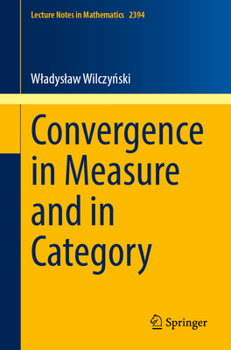
Convergence in Measure and in Category
No Customer Reviews

This book exhibits a vast gamut of similarities and differences between measure and (Baire) category. An important similarity is the Sierpiński-Erdős duality theorem: assuming the Continuum Hypothesis, there exists a one-to-one mapping f of the real line ℝ onto itself such that f(A) is a nullset if and only if A is of the first category. Moreover, this mapping can be chosen such that f = f-1. An equally important difference is E. Szpilrajn's theorem: there does not exist a mapping f of the real line ℝ onto itself such that f(E) is Lebesgue measurable if and only if E has the Baire property. Much of the book is devoted to the study of various modes of convergence: convergence almost everywhere; convergence except on a set of first category; convergence in measure; and convergence in the category of sequences of real functions of a real variable. Here, convergence in a category is *-convergence with respect to convergence except on a set of first category, just as convergence in measure is *-convergence with respect to convergence almost everywhere. The main focus is on sequences of real functions defined on the unit interval. If possible, theorems are proved in the more general setting of an abstract measurable space equipped with a sigma ideal. Sequences of functions that are divergent in measure or in category are also studied. In particular, the possibility of improving, destroying or preserving the convergence is addressed. The book will be valuable for those interested in real analysis and the theory of sequences or series of measurable functions.
Format:Paperback
Language:English
ISBN:3032231426
ISBN13:9783032231420
Release Date:June 2026
Publisher:Springer
Length:142 Pages
Customer Reviews
0 rating
Copyright © 2026 Thriftbooks.com
Terms of Use | Privacy Policy | Do Not Sell/Share My Personal Information | Cookie Policy | Cookie Preferences | Accessibility Statement
ThriftBooks ® and the ThriftBooks ® logo are registered trademarks of Thrift Books Global, LLC
ThriftBooks ® and the ThriftBooks ® logo are registered trademarks of Thrift Books Global, LLC
