


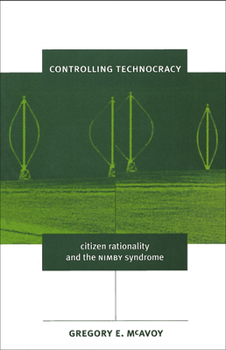
Controlling Technocracy: Citizen Rationality and the Nimby Syndrome
No Customer Reviews

Disputes over hazardous waste sites usually are resolved by giving greater weight to expert opinion over public "not-in-my-back-yard" reactions. Challenging the assumption that policy experts are better able to discern the general welfare, Gregory E. McAvoy here proposes that citizen opinion and democratic dissent occupy a vital, constructive place in environmental policymaking. McAvoy explores the issues of citizen rationality, the tension between democracy and technocracy, and the link between public opinion and policy in the case of an unsuccessful attempt to site a hazardous waste facility in Minnesota. He shows how the site was defeated by citizens who had reasonable doubts over the need for the facility. Offering a comprehensive look at the policymaking process, McAvoy examines the motivations of public officials, the resources they have for shaping opinion, the influence of interest groups, and the evolution of waste reduction programs in Minnesota and other states. Integrating archival material, interviews, and quantitative survey data, he argues that NIMBY movements can bring miscalculations to light and provide an essential check on policy experts' often partisan views. This book will be of value to those who work or study in the fields of hazardous waste policy, facility siting, environmental policy, public policy, public administration, and political science.
Format:Paperback
Language:English
ISBN:0878407413
ISBN13:9780878407415
Release Date:November 1999
Publisher:Georgetown University Press
Length:184 Pages
Weight:0.65 lbs.
Dimensions:0.5" x 5.9" x 9.0"
Grade Range:Postsecondary and higher
Customer Reviews
0 rating
Copyright © 2026 Thriftbooks.com Terms of Use
| Privacy Policy | Do Not
Sell/Share My Personal Information | Cookie Policy | Cookie Preferences | Accessibility Statement
ThriftBooks® and the ThriftBooks® logo are registered trademarks of Thrift Books Global, LLC
ThriftBooks® and the ThriftBooks® logo are registered trademarks of Thrift Books Global, LLC
