


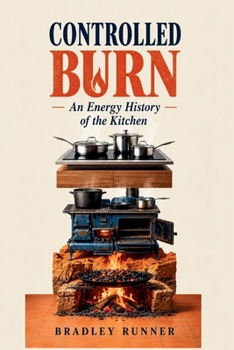
Controlled Burn: An Energy History of the Kitchen

Sometime this morning you turned a knob roughly the width of a bottle cap, and within minutes you had boiling water. The whole transaction took about four seconds of your attention.
Behind that knob is a valve. Behind the valve, a pipe or a wire. Behind those, a distribution network, a transmission system, a generating fleet or a compressor chain, a processing plant, a mine or a wellhead - and, at the far end, a formation of rock laid down before anything with a spine walked on land.
Controlled Burn is the history of that chain, told from the one place almost nobody studies it: the kitchen.
Across eleven thousand years, every improvement in cooking heat delivered something real - more control, more speed, less labour, less danger. And every single one of them moved the cost somewhere the cook could not see.
What you'll find inside: Why coal beat wood in England - not because the forests ran out, but because coal could float and wood could notThe exiled American spy who disproved the leading theory of heat by boiling water with a blunt drill, then redesigned the kitchenWhy more efficient engines made Britain burn ten times more coal, and why the same effect explains failures in energy policy todayHow a utility's accounting problem - plants sitting idle at midday - determined which appliances ended up in your kitchen, and which alternatives were quietly outspentWhy the white enamel kitchen of the 1950s ran on coal, and used more fuel per meal than the sooty gas one it replacedWhy fifty years and enormous sums spent on clean cookstoves for two billion people delivered so little - and what the failure teachesWhy roughly half of humanity is alive because of natural gas, for reasons that have nothing to do with cookingA method, not a sermon.This book does not tell you what to think about the current argument over gas stoves. It shows you that the same argument was held in 1850, in 1890, and in 1930 - that on each occasion the objectors were right about something real, and that societies accepted the loss anyway.
What it offers instead is four questions, derived from stoves and portable to anything with a supply chain and a user interface: What is gained? What does it cost? Who pays? And where does the cost go - somewhere visible, or somewhere not?
Where researchers disagree, this book describes the disagreement rather than picking the version that reads better. Where a number is an estimate, it says so.
Eighteen chapters, fourteen figures, and one persistent finding: the cost never disappeared. It only ever moved - and it always moved downhill.
For readers who like large histories built out of ordinary objects.
Customer Reviews
ThriftBooks ® and the ThriftBooks ® logo are registered trademarks of Thrift Books Global, LLC
