


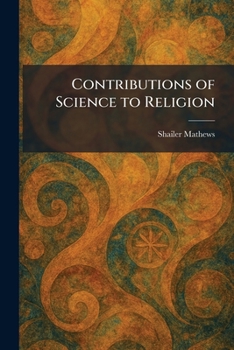
Contributions of Science to Religion

Select Format
Select Condition 
Book Overview
"Contributions of Science to Religion" is a profound exploration of the intersection between empirical discovery and spiritual faith. Authored by the distinguished theologian Shailer Mathews, this work seeks to reconcile the perceived conflicts between scientific advancement and religious doctrine during a transformative era in intellectual history. Mathews argues that rather than being mutually exclusive, science and religion offer complementary insights into the nature of existence and the evolution of human values.
The book examines how scientific methodology and findings-particularly in the realms of biology and physics-can enrich theological perspectives. By moving away from rigid dogmatism, Mathews presents a vision of religion that is dynamic, adaptable, and informed by the wonders of the natural world. He emphasizes the importance of understanding the universe as a coherent system, where scientific laws reflect a deeper spiritual order. This work remains a significant contribution to the field of modern theology, offering a sophisticated defense of religious modernism and the Social Gospel movement. Readers interested in the history of science, philosophy, and the ongoing dialogue between faith and reason will find "Contributions of Science to Religion" to be an insightful and enduring study of the human quest for meaning.
This work has been selected by scholars as being culturally important, and is part of the knowledge base of civilization as we know it. This work was reproduced from the original artifact, and remains as true to the original work as possible. Therefore, you may see the original copyright references, library stamps (as most of these works have been housed in our most important libraries around the world), and other notations in the work.
This work is in the public domain in the United States of America, and possibly other nations. Within the United States, you may freely copy and distribute this work, as no entity (individual or corporate) has a copyright on the body of the work.
As a reproduction of a historical artifact, this work may contain missing or blurred pages, poor pictures, errant marks, etc. Scholars believe, and we concur, that this work is important enough to be preserved, reproduced, and made generally available to the public. We appreciate your support of the preservation process, and thank you for being an important part of keeping this knowledge alive and relevant.
Customer Reviews
ThriftBooks® and the ThriftBooks® logo are registered trademarks of Thrift Books Global, LLC
