


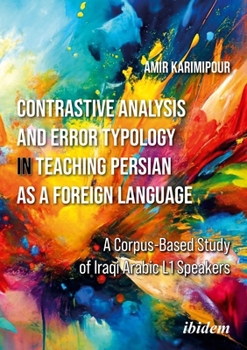
Contrastive Analysis and Error Typology in Teaching Persian as a Foreign Language: A Corpus-Based Study of Iraqi Arabic L1 Speakers

This volume presents the results of a major three-year longitudinal study (2023-2025) at Ilam University's AZFA Center on Persian acquisition by Iraqi Arabic-speaking learners. Based on an unprecedented corpus--847 hours of spoken data and 1.18 million written words from 312 learners (A2-B2)--it ranks among the most comprehensive investigations of this language pair.
Despite extensive lexical and typological overlap, Arabic L1 learners show persistent difficulties with the ezafe construction, compound verbs, and certain phonological contrasts--challenges predicted by contrastive analysis but previously under-documented empirically.
Through detailed error analysis and interlanguage tracking, this book identifies which predicted issues truly persist, offering robust evidence to replace intuition with data.
SLA researchers gain a richly documented case of Persian interlanguage in an understudied population, advancing understanding of cross-linguistic influence in closely related, high-contact languages.
Persian instructors working with Arabic speakers receive clear, evidence-based insights into genuine trouble spots plus practical pedagogical recommendations.
Curriculum developers and program administrators find concrete, data-driven guidance for designing effective Persian programs tailored to Arabic L1 learners.
An essential resource for applied linguistics, second language acquisition, and language contact studies.
Customer Reviews
ThriftBooks ® and the ThriftBooks ® logo are registered trademarks of Thrift Books Global, LLC
