


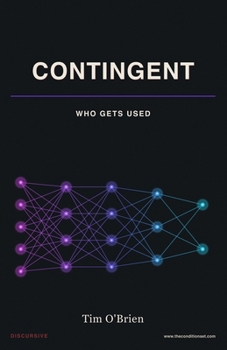
Contingent: Who Gets Used (The Condition Set)
No Customer Reviews

The models still work. What's scarce is permission to turn them on. In 2029, the law is new: no AI decision that touches human lives without a human signature. The signature is what makes AI legal, insurable, and financeable. The law never says what happens to the human who signs. Rob Coleman wrote the post-incident review of the Calloway Incident - sabotage that ran unwatched for weeks inside a pharmaceutical logistics system and killed 2,130 people. His review became the backbone of the new rules. Now he is a consultant, hired to certify Northstar, the country's leading maker of legally deployable AI, while a billionaire's acquisition waits on his name and hospitals wait on a finished routing system. Then he opens the audit log. It says a certified orchestrator named Nadia Cho approved a refrigerated-vaccine route. Nadia says she never saw the screen. Her credential is real. The approval is not. The institution would like her to sign a statement saying she made the decision. That would be simplest for everyone. Rob's signature can protect Nadia, preserve the standard he is certifying, or turn on the systems the clinics are waiting for. It cannot do all three. Contingent is Book II of The Condition Set. Redundant asked who gets cut when automation reshapes work. Contingent asks who gets used when regulation demands a human name - without funding the protection of the person who provides it. This is not a novel about rogue AI. The suspense is institutional: audit chains, certification records, a labor table, an enforcement interview, and a tired orchestrator realizing her name is already on the file. For readers of The Warehouse, Severance, Burn-In, and The Ministry for the Future.
Format:Paperback
Language:English
ISBN:B0HHTQVZ9J
ISBN13:9798997885908
Release Date:September 2026
Publisher:Discursive
Length:323 Pages
Weight:0.70 lbs.
Dimensions:7.8" x 0.7" x 5.1"
Customer Reviews
0 rating
Copyright © 2026 Thriftbooks.com
Terms of Use | Privacy Policy | Do Not Sell/Share My Personal Information | Cookie Policy | Cookie Preferences | Accessibility Statement
ThriftBooks ® and the ThriftBooks ® logo are registered trademarks of Thrift Books Global, LLC
ThriftBooks ® and the ThriftBooks ® logo are registered trademarks of Thrift Books Global, LLC
