
Skip to content
Scan a barcode
Scan
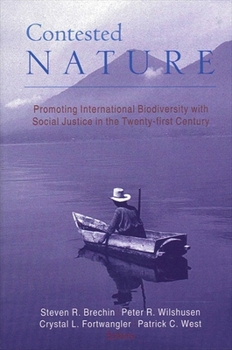
Paperback Contested Nature: Promoting International Biodiversity with Social Justice in the Twenty-first Century Book

ISBN: 0791457761

ISBN13: 9780791457764

Contested Nature: Promoting International Biodiversity with Social Justice in the Twenty-first Century

Select Format

Select Condition ThriftBooks Help Icon

Recommended

Format: Paperback

Condition: New

$43.56
Ships within 2-3 days
Save to List

Book Overview

Contends that effective biological conservation and social justice must go hand in hand.

How can the international conservation movement protect biological diversity, while at the same time safeguarding the rights and fulfilling the needs of people, particularly the poor? Contested Nature argues that to be successful in the long-term, social justice and biological conservation must go hand in hand. The protection of nature is a complex social enterprise, and much more a process of politics, and of human organization, than ecology. Although this political complexity is recognized by practitioners, it rarely enters into the problem analyses that inform conservation policy. Structured around conceptual chapters and supporting case studies that examine the politics of conservation in specific contexts, the book shows that pursuing social justice enhances biodiversity conservation rather than diminishing it, and that the fate of local peoples and that of conservation are completely intertwined.

Customer Reviews

1 rating

A Guide to Successful Biodiversity Conservation

This book came to my attention and interest after reading John Terbough's fine book "Requiem for Nature". I was interested in a book that offered solutions and insights into the problems of biodiversity protection that Terbough had described in his book. Enough time has passed from some of the early efforts in protection of nature reserves in the tropics that an assessment of success can be made and an analysis of problems. This book was exactly what I was looking for as it makes the holistic assessment and analysis of parks and reserves. What has often been omitted in efforts to preserve biodiversity is a strategy to work with the local population that has lived in or near the parks and have made their living with the parks resources. All to often in the past these people have been forcibly removed and have justifiably become adversaries of parks and conservation. Foreign conservation organizations and national governments have made mistakes in destroying locally successful conservation strategies due to a lack of a sociological perspective and review. The four editors of the book have looked at this as a sociological problem and have collected the essays and studies together for this book. They mention that "The most likely alternative to socially just conservation is increasing levels of resistance and conflict at all geographic scales, a situation that can derail attempts at nature protection." Six key concepts in socially just conservation and political processes to enhance nature protection are explored in this work including: 1. Human Dignity-Establishing a Strong Moral Foundation for Social Process. 2. Legitimacy-Constructing Authority. 3. Governance-Establishing Modes of Decision Making and Power Sharing. 4. Accountability-Guaranteeing Responsibility and Performance. 5. Adaptation and Learning-Institutionalizing Reflection and Self-Correction. 6. Non-local Forces-Analysis of the influence of National,International firms and their relationships to State and National elites in decision making. With my education in biology and health care and its perspective parts of the book seemed a bit arcane, especially the third chapter by Peter Wilshusen on "Exploring the Political Contours of Conservation". The Section including "Critical Social Theory and the Dual Nature of Structure" was a very abstract academic perspective on the role of power players in park organization, establishment, and regulation that I personally found difficult to comprehend. The majority of the book is set with more concrete examples of the social problems of illegal residents, poverty, ecotourism, local and regional control issues that have been studied in Asia, Africa, South America and the Caribbean. This is the heart of the compilation and each site study is rich with unique solutions that are found and accomplished only during work in the field with the people that have the most to gain or lose and are the key in conserving tropical nature
Copyright © 2026 Thriftbooks.com Terms of Use | Privacy Policy | Do Not Sell/Share My Personal Information | Cookie Policy | Cookie Preferences | Accessibility Statement
ThriftBooks® and the ThriftBooks® logo are registered trademarks of Thrift Books Global, LLC

GoDaddy Verified and Secured