


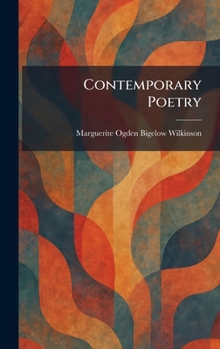
Contemporary Poetry

"Contemporary Poetry", curated by the distinguished critic and poet Marguerite Ogden Bigelow Wilkinson, serves as a premier anthology showcasing the vibrant landscape of verse during the early twentieth century. Compiled at a pivotal moment in literary history, this collection brings together the voices that defined the modern era, offering readers a comprehensive look at the evolution of poetic form and expression in both American and British literature.
The work provides not only a selection of significant poems but also insightful commentary that places these pieces within their cultural and aesthetic contexts. Wilkinson explores themes of nature, humanity, and the changing social fabric of the post-war world, highlighting the shift toward modernism and the experimentation that characterized the period. Featured poets represent a diverse array of styles, from traditional lyricism to the emerging free verse movement.
This volume remains an essential resource for students of literature and lovers of poetry alike, capturing the spirit of an age defined by creative ferment. Through "Contemporary Poetry", readers can rediscover the foundational works that shaped the trajectory of 20th-century literature and appreciate the enduring power of the written word.
This work has been selected by scholars as being culturally important, and is part of the knowledge base of civilization as we know it. This work was reproduced from the original artifact, and remains as true to the original work as possible. Therefore, you may see the original copyright references, library stamps (as most of these works have been housed in our most important libraries around the world), and other notations in the work.
This work is in the public domain in the United States of America, and possibly other nations. Within the United States, you may freely copy and distribute this work, as no entity (individual or corporate) has a copyright on the body of the work.
As a reproduction of a historical artifact, this work may contain missing or blurred pages, poor pictures, errant marks, etc. Scholars believe, and we concur, that this work is important enough to be preserved, reproduced, and made generally available to the public. We appreciate your support of the preservation process, and thank you for being an important part of keeping this knowledge alive and relevant.
Customer Reviews
ThriftBooks ® and the ThriftBooks ® logo are registered trademarks of Thrift Books Global, LLC
