


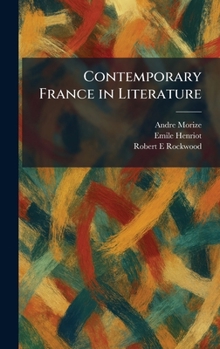
Contemporary France in Literature

"Contemporary France in Literature" offers a comprehensive examination of the vibrant intellectual and cultural landscape of early twentieth-century France through the lens of its written works. Curated by noted scholars Andre Morize, Emile Henriot, and Robert E. Rockwood, this volume serves as both a literary survey and a socio-historical document. It explores how French authors responded to the shifting social norms, political upheavals, and aesthetic innovations that defined the era following the First World War.
The text provides critical insights into the themes of modernity, tradition, and national identity as reflected in the prose and poetry of the period. By analyzing the relationship between literature and the evolving French society, the authors illuminate the ways in which creative expression served to mirror and mold the collective consciousness of the nation. This work is an essential resource for students of French studies and readers interested in the intersection of history and literature. It captures a pivotal moment in European cultural history, documenting the transition from classical foundations to the bold experiments of the contemporary age. "Contemporary France in Literature" remains a valuable guide for understanding the foundations of modern French thought and the enduring legacy of its literary masters.
This work has been selected by scholars as being culturally important, and is part of the knowledge base of civilization as we know it. This work was reproduced from the original artifact, and remains as true to the original work as possible. Therefore, you may see the original copyright references, library stamps (as most of these works have been housed in our most important libraries around the world), and other notations in the work.
This work is in the public domain in the United States of America, and possibly other nations. Within the United States, you may freely copy and distribute this work, as no entity (individual or corporate) has a copyright on the body of the work.
As a reproduction of a historical artifact, this work may contain missing or blurred pages, poor pictures, errant marks, etc. Scholars believe, and we concur, that this work is important enough to be preserved, reproduced, and made generally available to the public. We appreciate your support of the preservation process, and thank you for being an important part of keeping this knowledge alive and relevant.
Customer Reviews
ThriftBooks ® and the ThriftBooks ® logo are registered trademarks of Thrift Books Global, LLC
