


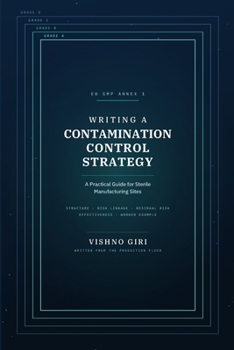
CONTAMINATION CONTROL STRATEGY: A practical guide for sterile manufacturing sites — structure, risk linkage, residual risk and proof of effectiveness
No Customer Reviews

Annex 1 tells you to have a Contamination Control Strategy. It does not tell you what one looks like.
So sites produce one of two things. A four-hundred-page compilation of every procedure that touches contamination - thorough in the way a filing cabinet is thorough, and read by nobody. Or a short document listing each required element with a sentence saying it is controlled, and a cross-reference to an SOP. Neither is a strategy. Neither survives a serious inspection. A strategy requires that you understand how your controls interact, where your residual risk actually sits, which single points of failure you are carrying, and what evidence would tell you the whole arrangement had started to fail. That understanding is what an experienced inspector is looking for. This book is a method for producing it. What is inside
Eight failure patterns - how CCS documents fail inspection, why each one happens, what an inspector does when they find it, and the fix
A document architecture with section-by-section page targets, so you know what you are building before you start writing
Element-by-element guidance across facility design, utilities, personnel, materials, aseptic process simulation, cleaning and monitoring - each with the evidence that demonstrates control, the questions you will be asked, and the weaknesses that recur
The risk linkage method - analysing by contamination route instead of by element, testing whether apparently redundant controls can actually fail independently, and identifying the controls that carry the weight
How to prove effectiveness - the section most strategies omit entirely, with leading and lagging indicators and a rule for choosing them
Inspection preparation, including paired weak and strong answers to the questions that are actually asked
A complete worked example for a small injectable site - route list, mapping table, residual risk statements and indicator set
Tools you can use immediately - a twelve-question self-assessment, a route mapping template, an element coverage checklist and a review meeting agenda
Written to be read
Around 220 pages. A quality manager with a deadline should be able to read it over a weekend and start work on Monday. Where completeness and usefulness conflicted, usefulness won. Who it is for
Quality managers and heads of quality at sterile manufacturing sites. Production managers on injectable and aseptic lines. Microbiology and environmental monitoring leads. Validation and qualification engineers. Consultants building strategies for client sites. Anyone preparing a sterile facility for inspection. Written by someone who works in injectable manufacturing production - not by a consultant who left the floor twenty years ago.
So sites produce one of two things. A four-hundred-page compilation of every procedure that touches contamination - thorough in the way a filing cabinet is thorough, and read by nobody. Or a short document listing each required element with a sentence saying it is controlled, and a cross-reference to an SOP. Neither is a strategy. Neither survives a serious inspection. A strategy requires that you understand how your controls interact, where your residual risk actually sits, which single points of failure you are carrying, and what evidence would tell you the whole arrangement had started to fail. That understanding is what an experienced inspector is looking for. This book is a method for producing it. What is inside
Eight failure patterns - how CCS documents fail inspection, why each one happens, what an inspector does when they find it, and the fix
A document architecture with section-by-section page targets, so you know what you are building before you start writing
Element-by-element guidance across facility design, utilities, personnel, materials, aseptic process simulation, cleaning and monitoring - each with the evidence that demonstrates control, the questions you will be asked, and the weaknesses that recur
The risk linkage method - analysing by contamination route instead of by element, testing whether apparently redundant controls can actually fail independently, and identifying the controls that carry the weight
How to prove effectiveness - the section most strategies omit entirely, with leading and lagging indicators and a rule for choosing them
Inspection preparation, including paired weak and strong answers to the questions that are actually asked
A complete worked example for a small injectable site - route list, mapping table, residual risk statements and indicator set
Tools you can use immediately - a twelve-question self-assessment, a route mapping template, an element coverage checklist and a review meeting agenda
Written to be read
Around 220 pages. A quality manager with a deadline should be able to read it over a weekend and start work on Monday. Where completeness and usefulness conflicted, usefulness won. Who it is for
Quality managers and heads of quality at sterile manufacturing sites. Production managers on injectable and aseptic lines. Microbiology and environmental monitoring leads. Validation and qualification engineers. Consultants building strategies for client sites. Anyone preparing a sterile facility for inspection. Written by someone who works in injectable manufacturing production - not by a consultant who left the floor twenty years ago.
Format:Paperback
Language:English
ISBN:B0HG5WGRWT
ISBN13:9798194035564
Release Date:August 2026
Publisher:Independently published
Length:136 Pages
Weight:0.43 lbs.
Dimensions:9.0" x 0.3" x 6.0"
Customer Reviews
0 rating
Copyright © 2026 Thriftbooks.com
Terms of Use | Privacy Policy | Do Not Sell/Share My Personal Information | Cookie Policy | Cookie Preferences | Accessibility Statement
ThriftBooks ® and the ThriftBooks ® logo are registered trademarks of Thrift Books Global, LLC
ThriftBooks ® and the ThriftBooks ® logo are registered trademarks of Thrift Books Global, LLC
