


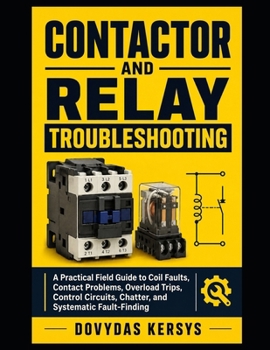
Contactor and Relay Troubleshooting: A Practical Field Guide to Coil Faults, Contact Problems, Overload Trips, Control Circuits, Chatter, and Systemat

A contactor will not pull in. A relay clicks, but the load does not operate. A motor refuses to start, the overload keeps tripping, or a contactor chatters loudly inside the control panel.
The fault may be inside the device-or somewhere in the control circuit feeding it.
Contactor and Relay Troubleshooting is a practical field guide for maintenance technicians, industrial electricians, service engineers, and automation students who need to diagnose contactor and relay faults systematically instead of replacing components at random.
The book is built around one simple principle:
Every contactor and relay has two sides: the coil and the contacts.
When a device fails, the first questions are: Is the coil receiving the correct voltage? Is the coil operating mechanically? Are the contacts changing state and carrying the load correctly?
Inside, you will learn how to:
Understand how contactors and relays operateDistinguish contactors from control and interface relaysIdentify coils, armatures, return springs, main contacts, and auxiliary contactsRead coil voltage and contact ratings correctlyAvoid wrong-voltage coil replacementsUnderstand AC and DC coilsRead start/stop and seal-in control circuitsTrace contactor coils and contacts across electrical schematicsDiagnose a contactor that will not pull inDiagnose a contactor that will not drop outTest coils for open circuits, shorts, and incorrect resistanceFind worn, burned, high-resistance, or welded contactsDiagnose chatter, buzzing, and hummingCheck low coil voltage and control-supply voltage dropTroubleshoot overload relay trips and nuisance trippingDiagnose faulty auxiliary contacts and interlocksCheck plug-in relays, sockets, pins, and status LEDsFind intermittent mechanical and electrical faultsSelect a correctly rated replacementApply a repeatable multimeter-based troubleshooting methodPractical examples cover common industrial problems such as:
A contactor coil receiving no control voltageA coil receiving the correct voltage but failing to pull inA contactor remaining energized after the stop commandA damaged seal-in contact causing immediate drop-outA tripped overload preventing the coil from energizingLow voltage causing the armature to chatterDirty pole faces causing an AC contactor to buzzMain contacts closing but failing to deliver powerWelded contacts keeping a motor energizedA relay LED turning on while its contacts fail to switchA corroded relay pin or loose socket causing intermittent operationRepeated coil burnout caused by an incorrect voltage ratingPremature contact wear caused by incorrect load selectionThe guide also explains contact ratings, utilisation categories, auxiliary contacts, overload protection, interlocking, control-circuit schematics, replacement selection, and good maintenance practices.
Its examples use common European industrial conventions, including KM contactor designations, K relay designations, A1/A2 coil terminals, 24 V DC control circuits, and 230/400 V AC systems, while the troubleshooting principles apply broadly to industrial machinery.
Because contactors often switch dangerous mains voltages, the book also emphasizes safe isolation, verification, and respect for the power side of the circuit.
Whether you are facing a motor that will not start, a relay that behaves intermittently, or a contactor that buzzes, burns, or refuses to release, this guide will help you identify the real cause and make a lasting repair.
Check the coil. Test the contacts. Find the cause.
Customer Reviews
ThriftBooks ® and the ThriftBooks ® logo are registered trademarks of Thrift Books Global, LLC
