


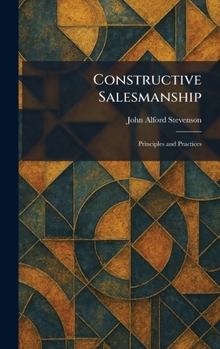
Constructive Salesmanship: Principles and Practices

"Constructive Salesmanship, Principles and Practices" is a comprehensive guide to the art and science of professional selling. Written by John Alford Stevenson, this seminal work explores the psychological foundations of the sales process and the practical methods required to build long-term success in business. The text moves beyond mere transactional techniques, emphasizing the importance of constructive salesmanship-an approach focused on providing genuine value to the customer and fostering mutual benefit.
Stevenson provides a structured framework for the entire sales lifecycle, from the initial prospect analysis and the pre-approach to the final close and post-sale service. The work highlights the necessity of self-development for the salesperson, detailing how personality, knowledge, and integrity contribute to professional effectiveness. Readers will find detailed discussions on handling objections, the psychology of persuasion, and the ethical considerations that underpin a successful career in commerce.
As a notable contribution to early 20th-century business literature, this volume offers timeless insights into the human interactions that drive the marketplace. It remains a valuable resource for students of marketing history, sales professionals seeking to refine their craft, and anyone interested in the foundational principles of effective commercial communication.
This work has been selected by scholars as being culturally important, and is part of the knowledge base of civilization as we know it. This work was reproduced from the original artifact, and remains as true to the original work as possible. Therefore, you may see the original copyright references, library stamps (as most of these works have been housed in our most important libraries around the world), and other notations in the work.
This work is in the public domain in the United States of America, and possibly other nations. Within the United States, you may freely copy and distribute this work, as no entity (individual or corporate) has a copyright on the body of the work.
As a reproduction of a historical artifact, this work may contain missing or blurred pages, poor pictures, errant marks, etc. Scholars believe, and we concur, that this work is important enough to be preserved, reproduced, and made generally available to the public. We appreciate your support of the preservation process, and thank you for being an important part of keeping this knowledge alive and relevant.
Customer Reviews
ThriftBooks ® and the ThriftBooks ® logo are registered trademarks of Thrift Books Global, LLC
