


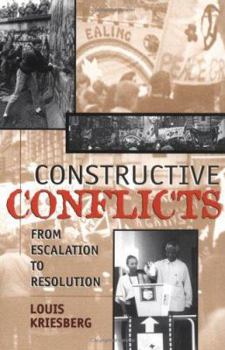
Constructive Conflicts

Select Format
Select Condition 
Book Overview
This comprehensive analysis of all kinds of social and political conflicts reveals an important, but neglected truth: conflicts often are waged constructively. Constructive Conflicts: From Escalation to Resolution makes it clear how that can occur at each stage of a conflict's course-from emergence, escalation, de-escalation, termination, and finally, to resolution. Kriesberg compares and synthesizes a wide variety of theoretical approaches, drawing from the social sciences, especially sociology, political science, anthropology, and social psychology, but also from the newer interdisciplinary fields of conflict resolution, peace studies, feminism, and security studies. Case studies and quantitative data about a wide variety of conflicts are used, including community and labor management conflicts, class and political revolutionary struggles, and gender-related struggles in small and large-scale settings. Kriesberg gives particular attention to major inter-state and inter-ethnic conflicts. These include the American Civil Rights struggle of the 1960s, the struggle against apartheid in South Africa, the Cold War between the U.S. and the Soviet Union and its transformation, and the tranformations of the Israeli-Arab conflicts. Drawing on past and current theory, research, and practice, Constructive Conflicts presents a systematic and coherent approach to understanding how a wide variety of struggles can be waged constructively in a new global context.
Format:Paperback
Language:English
ISBN:0847688925
ISBN13:9780847688920
Release Date:January 1
Publisher:Rowman & Littlefield Publishers, Incorporated
Length:416 Pages
Weight:1.20 lbs.
Dimensions:9.0" x 1.0" x 6.0"
Customer Reviews
1 rating
Refreshingly Different
Published by Thriftbooks.com User , 25 years ago
In the ever-expanding field of conflict resolution literature, Louis Kriesberg's work is most prominent. Instead of conceiving of conflict as an abnormal state that needs be abolished, he instead considers that it is a normative state of affairs between parties. The key is not to 'resolve' or precipitate an end to conflicts, but is rather to transform the conflict from a destructive (negative-sum or zero-sum) to a constructive (positive-sum) framework. Toward this end, he offers an impressive catalogue of methods that might be considered for application, and examines a myriad of factors that play a role in constructing the framework of conflict.His is a particularly broad-minded approach, as Kriesberg even refuses to dismiss all armed, violent conflicts as implicitly destructive, rather arguing that there may be tangible positives that arise (though these are, for Kriesberg, primarily oriented toward inducing both parties to recognise the need to broker a settlement). Through this book, Kriesberg looks to alter the manner in which the scholarly and diplomatic worlds consider conflict and its resolution (transformation). This is nothing short of a seminal work.
Copyright © 2026 Thriftbooks.com
Terms of Use | Privacy Policy | Do Not Sell/Share My Personal Information | Cookie Policy | Cookie Preferences | Accessibility Statement
ThriftBooks ® and the ThriftBooks ® logo are registered trademarks of Thrift Books Global, LLC
ThriftBooks ® and the ThriftBooks ® logo are registered trademarks of Thrift Books Global, LLC
