
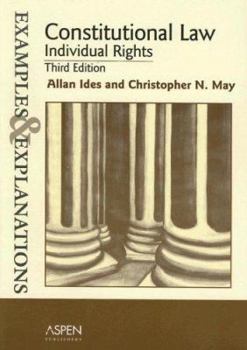
CONSTITUTIONAL LAW: Individual Rights: Examples & Explanations is part of a two-volume set that includes a corresponding treatment of National Power and Federalism. Now your students can get the specific extra guidance they need, when they need it. Organized to parallel the major casebooks, this inexpensive study guide adheres To The successful format of the Examples & Explanations Series: -Clear, readable text includes sufficient historical and theoretical detail to supply a solid overview -Examples bring the complex issues to life examples show students how to apply what they have learned in class -Explanations help students measure their understanding of the material and provide suggested answers and feedback. No other book offers such an engaging and effective approach. This accessible, high-quality, and intelligent study guide fills the gap between superficial outlines and overwhelming treatises. In a straightforward -- but not simplistic -- style, May and Ides address: -Substantive Due Process -The Takings Clause -The Contracts Clause -Procedural Due Process and Irrebuttable Presumptions -Equal Protection -The First Amendment - Freedom of Speech, Of the Press, and of Religion This comprehensive yet manageable guide is distinguished from the crowd of Con Law study aids by the level of practice it affords students. When you review Constitutional Law: Individual Rights: Examples and Explanations, you'll find it a worthy teaching partner, ideally suited To The needs of the first-year law student. Table of Contents Preface Acknowledgments Chapter One: Introduction to Individual Rights 1.1 Introduction and Overview 1.2 the 14th Amendment: An Introductory Overview 1.3 the Incorporation Doctrine 1.4 the State Action Doctrine 1.4.1 the Categorical Approach 1.4.2 the Two-Part Approach 1.5 Congressional Enforcement of the Civil War Amendments 1.5.1 Enforcement of the 13th Amendment 1.5.2 Enforcement of the 14th Amendment 1.5.3 Enforcement of the 15th Amendment Chapter Two: Substantive Due Process 2.1 Introduction and Overview 2.2 the Rise and Fall of Economic Due Process 2.2.1 Economic Due Process in the Lochner Era 2.2.2 the Demise of Lochner 2.2.3 Property and Economic Liberty Today 2.3 Noneconomic Liberty from Lochner to Carolene Products 2.3.1 the Lochner Era and Noneconomic Liberties 2.3.2 Carolene Products Footnote Four 2.4 Griswold And The Reemergence of Unenumerated Liberties 2.4.1 Penumbras and Emanations 2.4.2 Alternative Approaches: Liberty And The Ninth Amendment 2.4.3 the Risks in Protecting Unenumerated Rights 2.4.4 the Fundamental Rights Model with Variations 2.5 the Right of Privacy and Personal Autonomy 2.5.1 Marriage 2.5.2 Family Integrity 2.5.3 Intimate Association 2.5.4 Abortion 2.5.5 Sexual Intimacy: Bowers v. Hardwick 2.5.6 Medical Treatment 2.5.7 the Right to Refuse Lifesaving Hydration and Nutrition 2.5.8 Suicide and Physician-Assisted Suicide 2.6 Other Protected Liberty Interests 2.6.1 Freedom of Movement 2.6.2 the Rights to Protection and Care 2.7 What Happened to Life? Chapter Three: The Takings Clause 3.1 Introduction and Overview 3.2 Condemnation and Inverse Condemnation 3.3 an Approach to Analyzing Takings Problems 3.4 the Difference Between Physical Occupation and Regulation 3.5 Physical Occupations and Invasions 3.6 Regulatory Takings 3.6.1 Arbitrary Action 3.6.2 Defeating Investment Backed Expectations 3.6.3 Destroying All Use or Value 3.6.4 Partial Deprivations 3.6.5 the Nuisance Exception 3.6.6 Remedies for Temporary Regulatory Takings 3.7 the Requirement of Public Use 3.8 Conditions Attached to Building Permits 3.8.1 Only Certain Types of Conditions Qualify 3.8.2 the Essential Nexus Requirement 3.8.3 the R
The Redlich hornbook is a lot shorter and easier to read, but unfortunately is last updated in 1999. Until it is current, these are the best.
A Must Buy for Constitutional Law Students
Published by Thriftbooks.com User , 25 years ago
This book is the best study guide for Constitutional Law that I have read. It is written in narrative form, as opposed to outline form. The explanations of cases are clear and concise and reflect the nuances of the lenthy cases in this area where single-paragraph statements in outlines cannot. More importantly, the authors are well regarded constitutional law professors whose evaluations of the cases can be trusted to be accurate as well as even-handed.
ThriftBooks sells millions of used books at the lowest everyday prices. We personally assess every book's quality and offer rare, out-of-print treasures. We deliver the joy of reading in recyclable packaging with free standard shipping on US orders over $15. ThriftBooks.com. Read more. Spend less.

