


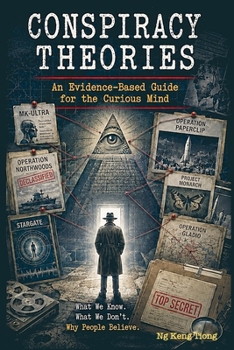
Conspiracy Theories: An Evidence-Based Guide for the Curious Mind

What if the greatest mystery isn't whether conspiracy theories are true-but how we decide what to believe?
We live in an age of unprecedented access to information-and unprecedented exposure to misinformation. Every day, extraordinary claims compete for our attention: secret government programs, UFOs, ancient civilizations, covert operations, hidden technologies, and unexplained phenomena. Some prove to be true. Many do not. Most occupy a complicated space between certainty and speculation.
How can an ordinary reader tell the difference?
Conspiracy Theories: An Evidence-Based Guide for the Curious Mind offers a refreshingly balanced approach. Rather than promoting sensational claims or dismissing them outright, this book equips readers with the tools to investigate extraordinary claims using evidence, logic, historical context, and intellectual humility.
Through engaging case studies-including Area 51, Roswell, MKULTRA, secret societies, unidentified anomalous phenomena (UAP), simulation theory, and other enduring mysteries-you will learn how to distinguish documented facts from informed speculation, evaluate competing explanations, recognize cognitive biases, identify logical fallacies, and measure confidence according to the strength of the available evidence.
More than a survey of conspiracy theories, this is a practical guide to disciplined inquiry in an age of information overload.
Inside you'll discover:
- A balanced examination of some of history's most intriguing mysteries
- A practical framework for evaluating evidence
- An investigator's toolkit for critical thinking
- An accessible guide to cognitive biases and logical fallacies
- A field checklist for assessing extraordinary claims
- A comprehensive glossary and curated reading guide for continued learning
Whether you approach these subjects as a skeptic, a believer, or simply a curious observer, this book invites you to replace preconceived assumptions with informed curiosity.
Because the pursuit of truth begins not with certainty, but with the courage to follow the evidence wherever it leads.
Related Subjects
History Political Science Politics & Social Sciences Social Science Social SciencesCustomer Reviews
ThriftBooks ® and the ThriftBooks ® logo are registered trademarks of Thrift Books Global, LLC
