


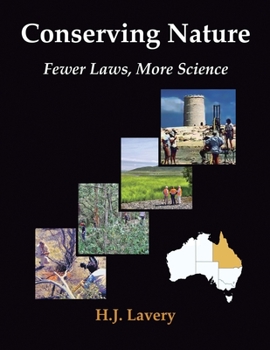
Conserving Nature: Fewer Laws, More Science
No Customer Reviews

Over-reliance on legislation to manage our environment has been a disappointing and costly endeavour. On the other hand during the past half century, scientific research - incorporating aboriginal and colonial histories - has productively addressed all of the major ecosystems across the resource-rich north-eastern quarter of the Australian continent (Queensland), from the arid lands of the far 'outback' to the equally colourful Great Barrier Reef, and settlements in between. The wide-ranging field experience described in unusual detail in this book concludes that the ecosystems are still self-sustaining - although much remains to be learnt about them. Their management to achieve the necessary sustainability needs to be based on ecological design using different techniques from those defined in current legislation (in turn, derived largely from public opinion). Using the field data, seven fundamental principles have been formulated to guide appropriate strategic planning. The 'environmental narrative' is identified and nominated as the critical tool to communicate critical land management practice to landholders - to be conveyed in the form of classic Australian stories pioneered collaboratively between scientists and creative artists. This direction needs to be adopted at the earliest possible moment for two selected top priority 'Areas of Outstanding Resources'.
Format:Paperback
Language:English
ISBN:B09HPPZLQH
ISBN13:9798533594721
Release Date:October 2021
Publisher:Independently Published
Length:376 Pages
Weight:2.66 lbs.
Dimensions:1.0" x 8.5" x 11.0"
Customer Reviews
0 rating
Copyright © 2026 Thriftbooks.com
Terms of Use | Privacy Policy | Do Not Sell/Share My Personal Information | Cookie Policy | Cookie Preferences | Accessibility Statement
ThriftBooks ® and the ThriftBooks ® logo are registered trademarks of Thrift Books Global, LLC
ThriftBooks ® and the ThriftBooks ® logo are registered trademarks of Thrift Books Global, LLC
