


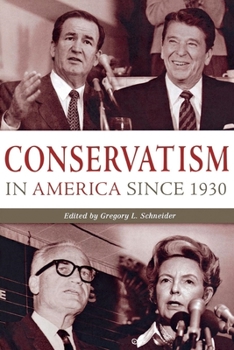
Conservatism in America Since 1930: A Reader


Select Format
Select Condition 
Book Overview
A collection of documents by conservative thinkers, tracing the rise and prevalence of conservatism in modern America
While there have long been libertarians, agrarians, individualists, collectivists, nationalists, and others who fit the contemporary label of "conservative," no cohesive conservative movement existed prior to World War II. How, then, did conservatism develop into such a powerful American political force? Tracing the history of conservatism from the concerns and ideas of the Old Right, through the Cold War, the "Gingrich revolution," and into the present, Conservatism in America Since 1930 gathers a wide range of conservative writings and documents showcasing the development and protean character of the modern conservative intellectual and political movement. The book includes essays from Russell Kirk, Milton Friedman, F.A. Hayek, William F. Buckley, Jr., Ronald Reagan, and Pat Buchanan, among others, and highlights key debates between the movement's factions. Along with essays by these canonical conservative figures, the volume also contains excerpts from sources less frequently cited, such as the Twelve Southerners and Seward Collins, as well as documents from conservative organizations and journals. The primary documents are supplemented by introductions which set the historical context and offer illuminating commentary on how conservatism shifted identity over the course of modern American history.Format:Paperback
Language:English
ISBN:0814797997
ISBN13:9780814797990
Release Date:June 2003
Publisher:New York University Press
Length:452 Pages
Weight:1.46 lbs.
Dimensions:0.8" x 6.1" x 8.9"
Customer Reviews
3 ratings
Thorough Representation of Conservatism
Published by Thriftbooks.com User , 16 years ago
I found that Dr. Schneider's literary selections in this book were an excellent representation of conservatism's diversity. Readers of this book will find documents written by many conservatives who played a significant role in formulating 20th century conservatism. This includes F. A. Hayek, Milton Friedman, William F. Buckley Jr., Barry Goldwater, Phyllis Schlafly, Ronald Reagan, etc. I found it refreshing to read these primary sources and get a true sense of what conservatism has been and what it is today, without having to listen to slanderous statements from pundits of both sides of the political spectrum. It is fairly easy to conclude that there has rarely, if ever, been a national conservative consensus on issues such as economics, politics, foreign policy, morals, social issues, and government. I am thankful that Dr. Schneider provided contrasting conservative perspectives on these topics. For example, in one essay Frank Meyer argues that libertarians are nothing more than libertines. Then in the following essay we read Murray Rothbard's glorification of libertarianism. This ideological conservative fracture seems to be ubiquitous throughout most of conservative history. Out of all of the primary sources in this book, I found Whittaker Chambers' "A Witness" to be the most moving essay. In the essay, Chambers describes his journey from first being a Communist working in the United States government and then breaking away from this ideology (or more correctly way of life) because he felt he had to choose between such polar dichotomies as "God or Man, Soul or Mind, Freedom or Communism." Despite Chambers' background he may be the one most in touch with what conservatism is. I highly recommend the book. Dr. Schneider provides valuable introductions to each section, which prepares the reader for the primary sources that follow. Along with the primary sources themselves, this is a meaningful book on conservatism.
Excellent collection of the movement's heavy hitters.
Published by Thriftbooks.com User , 20 years ago
It may come as a surprise to some critics - at least to those who reduce conservatism to either a form of corporatism or Christian theocracy - that the conservative movement has deep and diverse roots. This book collects some of the writings of the primary movers and discusses the similarities and differences between the ideas of each individual and movement. This is a collection of political theory, not a history of the politics over this period. However, that doesn't mean the discussion isn't dry or boring. Moreover, this makes it a book that will be useful as a reference guide for longer than most other political books put out for the lay reader.
A "big tent" in the best and most positive of ways
Published by Thriftbooks.com User , 22 years ago
This is a book that, in my humble opinion, probably should be on the desk of every self-described "conservative" leader and activist across America. It's that useful.I say "self-described," because one of the key recurring features in American conservative history has been the drive by one brand of "conservatives" to purge another brand from movement or party for not meeting the first brand's standards of "real" conservatism. Not surprisingly, therefore, some folks of one or another stripe might argue with the inclusion of the Buchananites, or the Rothbardians, or the Southern Agrarians, or the neo-cons in a book about "conservatives."As much as it is a documentary history of modern conservatism, though, this book is a useful reminder of how much the various shoots and branches of conservatism still have in common today. Anyone who has read, for example, Dinesh D'Souza's denunciation of libertarians in "Letters to a Young Conservative" would do well to read Rothbard's pre-emptive (1980) refutation of D'Souza's arguments in "What is Libertarianism?" (pp. 262-273). Similarly, the frequent willingness of some to credit William F. Buckley with "inventing" conservatism in the 1950s should note editor Schneider's deliberate dating of the contents of this volume back to 1930. While the vital contributions of Buckley and the Sharon Conference are not slighted, the roots of modern conservatism in the pre-war Old Right are here given the credit they deserve.There are many other important contributions here that deserve to be read and understood by conscientious conservatives. F.A. Hayek's 1959 work "Why I am not a Conservative" (pp. 180-194), as one example, is perhaps better known by its title than by the contents of Hayek's actual argument. For while he shows that he is not, in fact, *a* "conservative," he also reveals his devotion to ideals very much in line with tradition and a conservative approach to philosophy and life.Through it all, insightful essays and introductions by Schneider himself tie the individual readings together thematically, and also present the various themes and movements within the larger context of the history of American conservatism.On the whole, this volume probably won't resolve the principled differences between, say, Bill Kristol and Sam Francis. But it will help reveal how both men's philosophical stands arise from the same general pool of conservative history. It may not, and perhaps should not, reverse the "conservative crack-up" that has developed in the last years and decades and restore a unified "conservative movement." But it may at least provide a much-needed philosophical and historical context for anyone who uses that much-abused label to describe themselves. And given how few modern conservatives seem to know -- or care -- about their own history, that can only be a good thing.
Copyright © 2026 Thriftbooks.com
Terms of Use | Privacy Policy | Do Not Sell/Share My Personal Information | Cookie Policy | Cookie Preferences | Accessibility Statement
ThriftBooks ® and the ThriftBooks ® logo are registered trademarks of Thrift Books Global, LLC
ThriftBooks ® and the ThriftBooks ® logo are registered trademarks of Thrift Books Global, LLC
