


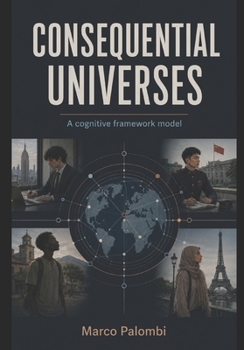
Consequential Universes: A Cognitive framework model

Consequential Universes is a cognitive framework model designed to manage the cognitive and behavioural variables generated by the technological shift toward the hive.
The crisis of thought is already visible in public life, institutions, education, politics, markets and personal behaviour. Attention is fragmented. Reality is increasingly mediated. Recognition is measured. Social signals circulate faster than reflection. Human environments no longer merely surround individuals; they enter cognition, reorganise perception and shape conduct before conscious judgement can fully stabilise.
This book gives a working frame for organising that transformation.
Originally conceived within the broader essay War on Thought, Consequential Universes now stands as an autonomous work. Its purpose is to provide a clear and immediate model capable of encasing the variables that emerge when culture, environment, technology, perception, behaviour and collective feedback begin to operate inside the same cognitive field.
The technological shift does not simply add new instruments to human life. It changes the conditions under which human beings perceive, compare, desire, imitate, judge and act. It expands the environment into a networked field of signals, rankings, images, reactions and behavioural pressures. From this field emerges the hive: a machine-mediated aggregation of perceptions, sanctions, expectations and responses that begins to shape the maps through which reality is socially recognised.
A consequential universe is an inhabited cognitive order that produces real effects. It is the map through which reality becomes readable, actionable and transmissible. When people act through such maps, those maps enter the world and become forces within it.
The urgency lies here: before manipulation becomes visible, the field of perception has already been formed. Before behaviour is influenced, reality has already been arranged into signs. Before a society recognises that its thought has changed, the environment in which thought occurs may already have changed.
Consequential Universes offers a framework for readers interested in political economy, sociology, anthropology, cognitive studies, media theory, institutional analysis and the contemporary transformation of thought.
It is a standalone essay and a conceptual entrance to the broader questions developed in War on Thought: how the technological shift produces new cognitive and behavioural variables, how those variables converge toward the hive, and how the worlds men inhabit become the worlds through which they think, judge, act and produce consequences.
Customer Reviews
ThriftBooks ® and the ThriftBooks ® logo are registered trademarks of Thrift Books Global, LLC
