


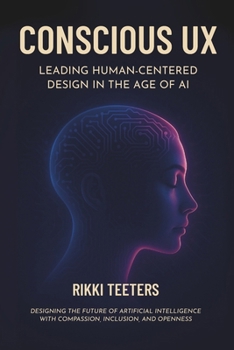
Conscious UX: Leading Human-Centered Design in the Age of AI: Designing the Future of Artificial Intelligence with Compassion, Inclusion, and Openness

Transform User Experience Design into a Force for Human Flourishing in the AI Age
By Rikki Teeters
When AI can design interfaces, what remains uniquely human?
Conscious UX is a bold, timely manifesto for designers and design leaders navigating an industry reshaped by artificial intelligence. As UX departments disappear, mass layoffs accelerate, and major platforms report that up to half their code is AI-generated, this book argues a radical truth:
Consciousness, not tools or tactics, is our irreplaceable advantage.
Drawing on 130 in-depth conversations with UX practitioners across six continents, Rikki Teeters reveals how designers who lead with awareness, empathy, and ethical presence are not just surviving the AI transition. They are shaping what comes next. This is a call to reclaim UX as a practice of human dignity, relationship, and purpose.
What You Will Learn
Real voices, real change
Insights from practitioners in Singapore, S o Paulo, Berlin, Nairobi, and beyond show how conscious UX leaders are thriving amid industry disruption.
Why humans still matter in product designDiscover why qualities AI cannot replicate, including guilt, moral intuition, emotional complexity, and embodied empathy, are the very skills the future of design depends on.
Practical, usable frameworksThe Conscious UX Framework(TM) offers concrete tools for leading human-centered design when AI handles the mechanics and automation.
Deep roots, timeless wisdomExplore how indigenous design principles, theatrical traditions, and ancient practices of presence reveal that consciousness has always been at the heart of meaningful creation.
Foreword by Brenda Laurel, Visionary UX Pioneer
The book opens with a powerful foreword by Brenda Laurel, the pioneer who introduced the term user experience through her theatrical work at Atari and Apple in the 1980s.
Now in her seventies, Laurel bridges ancient wisdom and emerging technology by writing poetry daily while consulting on AR projects that help children connect with nature. Her reflections illuminate a profound truth. Design has never been about interfaces alone. It has always been about relationship.
Why Conscious UX Matters Now
The headlines tell one story. Automation, layoffs, shrinking teams.
Conscious practitioners tell another.
They know our value was never in pushing pixels or mapping journeys.
It was always in our ability to feel user frustration in our bodies, to sense when technology crosses ethical lines, and to create from care rather than fear.
Conscious UX reframes the AI moment not as an existential threat, but as an invitation to mature the discipline.
Who This Book Is ForUX designers and researchersDesign and product leadersProduct managers navigating AI integrationTechnologists concerned with ethics and human impactAnyone shaping how technology affects lived experience
Whether you are defending your team's relevance or pioneering AI human collaboration, this book turns uncertainty into grounded, actionable leadership.
Transform Your Practice. Transform the Future.
In a world where AI generates code and automates design tasks, consciousness becomes the ultimate differentiator.
Conscious UX shows you how to lead with presence, design with intention, and keep human flourishing at the center of technological progress.
The age of unconscious UX is dead.
The age of Conscious UX has begun.
Customer Reviews
ThriftBooks® and the ThriftBooks® logo are registered trademarks of Thrift Books Global, LLC
