


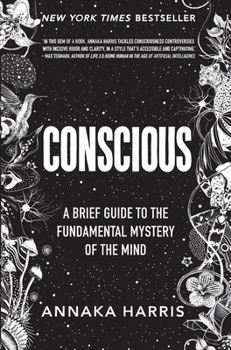
Conscious: A Brief Guide to the Fundamental Mystery of the Mind

Select Format
Select Condition 
Book Overview
NEW YORK TIMES BESTSELLER
"If you've ever wondered how you have the capacity to wonder, some fascinating insights await you in these pages." --Adam Grant, New York Times bestselling author of Originals
As concise and enlightening as Seven Brief Lessons on Physics and Astrophysics for People in a Hurry, this mind-expanding dive into the mystery of consciousness is an illuminating meditation on the self, free will, and felt experience.
What is consciousness? How does it arise? And why does it exist? We take our experience of being in the world for granted. But the very existence of consciousness raises profound questions at the heart of the philosophy of mind: Why would any collection of matter in the universe be conscious? How are we able to think about this? And why should we?
In this wonderfully accessible book, Annaka Harris guides us through the evolving definitions, philosophies, and scientific findings from modern neuroscience that probe our limited understanding of consciousness. Where does it reside, and what gives rise to it? Could it be an illusion, or a universal property of all matter? As we try to understand consciousness, we must grapple with how to define it and, in the age of artificial intelligence, who or what might possess it.
Conscious offers lively and challenging arguments that alter our ideas about consciousness and the illusion of self--allowing us to think freely about it for ourselves, if indeed we can.
The Hard Problem of Consciousness: Explore one of science's deepest questions: Why do we experience anything at all, and how does awareness arise from non-sentient matter?A Guide to the Science: Delve into the cutting-edge findings from neuroscience and physics, presented in a clear and accessible way for any reader.Free Will and the Illusion of Self: Investigate the compelling evidence suggesting our sense of a unified self and our feeling of conscious control may be powerful illusions created by the brain.Panpsychism and AI: Consider the radical possibilities--could consciousness be a fundamental property of all matter? And in the age of artificial intelligence, what other kinds of minds might exist?Customer Reviews
ThriftBooks® and the ThriftBooks® logo are registered trademarks of Thrift Books Global, LLC
