


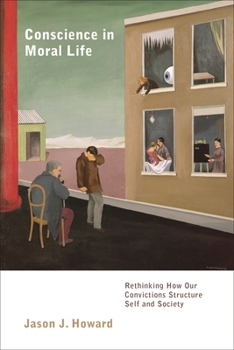
Conscience in Moral Life: Rethinking How Our Convictions Structure Self and Society
No Customer Reviews

Select Format
Select Condition 
Book Overview
The notion of conscience remains one of the most widely used moral concepts and a cornerstone of ordinary moral thinking. This book explores where this widespread confidence in conscience stems from, examining the history of conscience as a moral concept and its characteristic moral phenomenology.
Jason Howard provides a comprehensive reassessment of the function of conscience in moral life, detailing along the way the manifold problems that arise when we believe our conscience is more reliable than is actually warranted.
The result is a step-by-step evaluation of our most accepted assumptions. Howard goes on to argue, from a phenomenological perspective, that conscience is indispensable for understanding moral experience. He capitalizes on a dialectical perspective developed by Hegel and Ricoeur, in which conscience is seen as the recognition of the other, and integrates this with work in the philosophy of emotion, arguing that conscience is best seen in terms of the function it serves in moderating the moral emotions of shame, guilt and pride.
Jason Howard provides a comprehensive reassessment of the function of conscience in moral life, detailing along the way the manifold problems that arise when we believe our conscience is more reliable than is actually warranted.
The result is a step-by-step evaluation of our most accepted assumptions. Howard goes on to argue, from a phenomenological perspective, that conscience is indispensable for understanding moral experience. He capitalizes on a dialectical perspective developed by Hegel and Ricoeur, in which conscience is seen as the recognition of the other, and integrates this with work in the philosophy of emotion, arguing that conscience is best seen in terms of the function it serves in moderating the moral emotions of shame, guilt and pride.
Format:Paperback
Language:English
ISBN:1783480114
ISBN13:9781783480111
Release Date:March 2014
Publisher:Rowman & Littlefield Publishers
Length:226 Pages
Weight:0.80 lbs.
Dimensions:0.7" x 6.3" x 9.0"
Grade Range:Postsecondary
Related Subjects
PhilosophyCustomer Reviews
0 rating
Copyright © 2026 Thriftbooks.com Terms of Use
| Privacy Policy | Do Not
Sell/Share My Personal Information | Cookie Policy | Cookie Preferences | Accessibility Statement
ThriftBooks® and the ThriftBooks® logo are registered trademarks of Thrift Books Global, LLC
ThriftBooks® and the ThriftBooks® logo are registered trademarks of Thrift Books Global, LLC
