


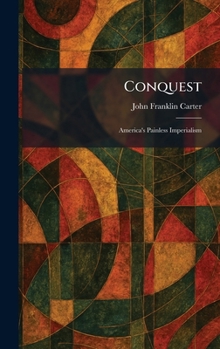
Conquest: America's Painless Imperialism

"Conquest; America's Painless Imperialism" offers a provocative analysis of the United States' expanding global influence during the early twentieth century. Written by John Franklin Carter, this work examines the unique nature of American expansionism, characterizing it not through traditional military subjugation, but through economic dominance, cultural penetration, and diplomatic maneuverability. Carter explores how the United States established a "painless" form of empire that wielded significant power over international affairs without the overt colonial structures favored by European powers.
The book delves into the mechanisms of American soft power, investigating how trade, finance, and industrial might served as the primary tools for establishing global hegemony. By dissecting the geopolitical landscape of the post-World War I era, "Conquest; America's Painless Imperialism" provides a contemporary perspective on the rise of the American century. It remains a significant historical document for readers interested in the evolution of American foreign policy, the history of international relations, and the subtle dynamics of economic imperialism. Carter's insights into the relationship between national prosperity and global political control offer a compelling look at the ideological foundations of the American role on the world stage.
This work has been selected by scholars as being culturally important, and is part of the knowledge base of civilization as we know it. This work was reproduced from the original artifact, and remains as true to the original work as possible. Therefore, you may see the original copyright references, library stamps (as most of these works have been housed in our most important libraries around the world), and other notations in the work.
This work is in the public domain in the United States of America, and possibly other nations. Within the United States, you may freely copy and distribute this work, as no entity (individual or corporate) has a copyright on the body of the work.
As a reproduction of a historical artifact, this work may contain missing or blurred pages, poor pictures, errant marks, etc. Scholars believe, and we concur, that this work is important enough to be preserved, reproduced, and made generally available to the public. We appreciate your support of the preservation process, and thank you for being an important part of keeping this knowledge alive and relevant.
Customer Reviews
ThriftBooks ® and the ThriftBooks ® logo are registered trademarks of Thrift Books Global, LLC
