


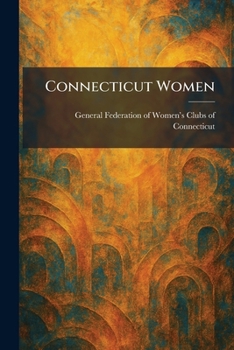
Connecticut Women

Select Format
Select Condition 
Book Overview
"Connecticut Women" serves as an essential historical chronicle detailing the lives, achievements, and civic contributions of women across the state of Connecticut during the early twentieth century. Prepared by members of the General Federation of Women's Clubs, this work documents the vital roles that women played in shaping the social, political, and cultural landscape of the region. The text highlights the growth of female leadership and the collective power of women's organizations in advancing social reform, education, and community welfare.
Through a series of biographical sketches and historical accounts, the book provides a deep look into the suffrage movement, the establishment of local charitable institutions, and the diverse professional accomplishments of Connecticut's female pioneers. This collection is more than a simple record; it is a testament to the spirit of activism and the enduring legacy of women who strove to improve their communities. It remains a valuable resource for those interested in New England history, gender studies, and the evolution of women's rights in America. By preserving these narratives, "Connecticut Women" ensures that the foundational efforts of these historical figures are recognized for their impact on modern society.
This work has been selected by scholars as being culturally important, and is part of the knowledge base of civilization as we know it. This work was reproduced from the original artifact, and remains as true to the original work as possible. Therefore, you may see the original copyright references, library stamps (as most of these works have been housed in our most important libraries around the world), and other notations in the work.
This work is in the public domain in the United States of America, and possibly other nations. Within the United States, you may freely copy and distribute this work, as no entity (individual or corporate) has a copyright on the body of the work.
As a reproduction of a historical artifact, this work may contain missing or blurred pages, poor pictures, errant marks, etc. Scholars believe, and we concur, that this work is important enough to be preserved, reproduced, and made generally available to the public. We appreciate your support of the preservation process, and thank you for being an important part of keeping this knowledge alive and relevant.
Customer Reviews
ThriftBooks ® and the ThriftBooks ® logo are registered trademarks of Thrift Books Global, LLC
