


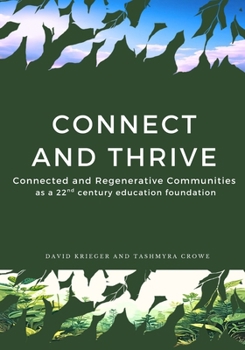
Connect and Thrive: Connected and Regenerative Communities as a 22nd Century Education Foundation

Connect and Thrive: Connected and Regenerative Communities as a 22nd Century Education Foundation introduces a new kind of education designed to help learners build the skills, knowledge, and relationships needed to support healthy communities and ecosystems. It offers both a narrative framework and a hands-on learning model based on decades of international experience and cross-cultural collaboration.
The book centers on the "River System of Human Time," a story that traces how human cultures have evolved over tens of thousands of years. It describes a shared starting point and the branching paths that led to different ways of living-some more connected to land and long-term care, others more focused on growth and control. Today, these paths meet in a moment of global challenge and possibility. The story invites readers to ask what kind of future we want and how we might get there together.
The Global Care Packs (GCP) programs introduced in this book are designed for that purpose. They include learning tracks for youth, communities, and Elder-mentors. All begin with the Connect and Thrive Foundation Course, which offers two pathways: a Narrative Tracking Path and an Experiential Tracking Path. The narrative path helps learners understand where we come from and how different systems have shaped our lives. The experiential path involves practices that build awareness, observation, and relationship with the natural world. Together, these tracks help learners build a "care pack" that holds both practical tools and meaningful insight.
The educational approach behind GCP is called Regeneration Partnership Education. It draws from a pragmatic constructivist framework, which treats knowledge as something created through interaction, experience, and reflection. This approach does not ask only what is true but also what is useful, what supports life, and what helps people solve problems in a changing world. It supports learning that is grounded, adaptable, and open to multiple ways of knowing.
Throughout the book, symbolic tools such as the 7 Directions Compass and other cultural frameworks are used to help learners connect ideas with lived experience. Practices like tracking, walking, journaling, storytelling, and shared observation are used as core methods for building understanding and connection. These practices strengthen the relationship between the learner, their community, and the wider web of life.
Connect and Thrive encourages each learner and educator to take part in shaping the future. The goal is both personal growth and the regeneration of relationships between people, place, knowledge, and action. The book shows how learning can be practical, meaningful, and shared across generations.
To fully engage with the regenerative approach described in this book, learners are encouraged to use Connect and Thrive alongside the experiential Foundation Course available at thrivingfutures2100.com. The course provides guided activities, journaling prompts, and group practices that support deep nature connection, prosocial development, and practical skill-building. Together, the book and course offer a complete learning experience that helps individuals and communities restore relationships, strengthen awareness, and take meaningful steps toward thriving futures.Customer Reviews
ThriftBooks ® and the ThriftBooks ® logo are registered trademarks of Thrift Books Global, LLC
