


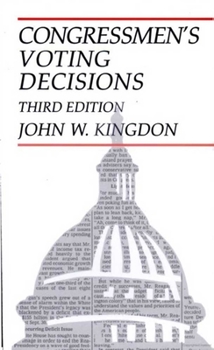
Congressmen's Voting Decisions


Select Format
Select Condition 
Book Overview
Congressmen's Voting Decisions, now in its third edition, is a classic, influential analysis of how members of the U.S. House of Representatives decide how to vote. Drawing on extensive, in-depth interviews with legislators, staff, lobbyists, and other actors in the policymaking process, John W. Kingdon moves beyond abstract theories to examine the real-world influences and rules of thumb that guide floor voting.Combining statistical analysis with qualitative fieldwork, Kingdon identifies and clarifies the roles played by various actors--including constituents, fellow congressmen, party and committee leaders, interest groups, the administration, staff, and the mass media. He argues that, far from being dominated by one factor, legislative decision-making is nuanced and adaptive, with members weighing information sources, constituency expectations, interpersonal cues, and their own policy attitudes. The book explores the pressures of modern congressional service, the rise of decentralized power through subcommittees and increased staff, and the evolving impact of campaign finance and party polarization.Revised to reflect key changes in the institution from the 1970s through the 1980s--including the rise of single-issue advocacy, institutional reforms, and the impact of divided government--this edition offers readers a rich framework for understanding both enduring patterns and contemporary developments in legislative behavior.Essential reading for students of American politics, political scientists, and informed citizens, Congressmen's Voting Decisions remains a foundational work for anyone interested in what truly shapes the decisions in America's legislative branch.
Format:Paperback
Language:English
ISBN:0472064010
ISBN13:9780472064014
Release Date:March 1989
Publisher:University of Michigan Press
Length:374 Pages
Weight:0.95 lbs.
Dimensions:0.8" x 5.5" x 8.5"
Customer Reviews
1 rating
Modeling Decision Making
Published by Thriftbooks.com User , 16 years ago
Kingdon attempts to explain why congressmen vote the way they do. He divides his explanation into two parts, (1) the role of various actors - constituents, fellow congressmen, party leaders, interest groups, etc. - on influencing the congressmen's voting decisions, and (2) more general aspects of decision making, i.e. information flow, the actual decision making process, the role of ideology and policy preference, etc. In regards to the role of actor, Kingdon finds that fellow congressmen have the most influence on decision making followed closely by the constituency. Fellow congressmen are the source of lots of information and as such can simply the decision making process. First, congressmen will pick a fellow congressman who is an expert on a particular policy area, and is also ideologically similar to the congressman. Similarly, a congressman may side with a more senior member, as they tend to have more experience on issues. All of these illustrate that relying on fellow congressman can decrease information costs and make the decision making process more simplified. Constituent influence plays a close second to fellow congressmen. The member is reliant on continued constituency support for reelection. However, the member also is influenced by the intensity of the wishes of the constituency. He is most likely to vote along with the wishes of the constituency the more intensely they hold their position. On issues that the constituency doesn't feel strongly, the member may vote against his district. Most of the time, however, the member votes with his or her district. They do so for four reasons. First, the congressman is recruited from the district. His views will not be so different. Second, the congressman will have to explain his voting decisions if they diverge from his constituents. Third, he receives a good deal of direct communication from the district regarding ideological direction, and he usually follows this direction. Lastly, and most importantly, electoral concerns drive compliance with constituent wishes. Kingdon also discusses some actors who possess significantly less influence. He begins with party leadership and committee members. Kingdon contends that they have less influence than commonly thought. He contends that party voting is less a result of leadership and committee chairs, and more a result of the fact that the constituencies of the parties differ. The constituencies will support policies most similar to one party or another and the congressmen will vote accordingly. Interest groups also have less power than commonly though. Congressmen may listen to interest groups to gain information, or procure assistance drafting legislation, but usually only if (a) the interest groups is closely tied with the constituency, (b) the interest group is ideologically similar to the congress may, or (c) the issue is highly salient. The executive branch also has less power than some would contend. If the p
Copyright © 2026 Thriftbooks.com Terms of Use
| Privacy Policy | Do Not
Sell/Share My Personal Information | Cookie Policy | Cookie Preferences | Accessibility Statement
ThriftBooks® and the ThriftBooks® logo are registered trademarks of Thrift Books Global, LLC
ThriftBooks® and the ThriftBooks® logo are registered trademarks of Thrift Books Global, LLC
