


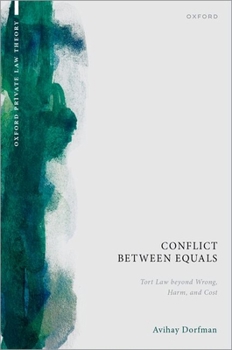
Conflict Between Equals: Tort Law Beyond Wrong, Harm, and Cost
No Customer Reviews

Conflict between Equals argues that tort law has to be understood and ultimately vindicated as the actualization of two theories: the conflict and the equality theory of tort law. It is not harm, wrongdoing, or social cost that gives us reason to have tort law in the first place. Instead, it is human conflict-specifically, conflict between our fundamental interests-that serves as the moral function of tort law. How we respond to such conflicts determines which harms, wrongs, or costs should, if at all, be addressed by tort law. The conflict theory elaborates on the nature and normative significance of three types of conflict: inherently valuable, tolerably valuable, and valueless. The theory emphasizes the importance of preventing valueless conflict, containing tolerably valuable conflict, and constructing the conditions necessary for inherently valuable conflict to arise. Moreover, the human conflict to which tort law responds reflects a commitment to treating the parties to a conflict as equals. The equality theory is grounded in the egalitarian ideal of relating as equals, thus tort law must determine terms of interaction that take seriously differences in the interests and conditions of the interacting parties. By doing so, tort law secures the ability of the parties in a conflict to relate as substantive, rather than merely formal, equals.
Format:Hardcover
Language:English
ISBN:0198979878
ISBN13:9780198979876
Release Date:July 2026
Publisher:Oxford University Press
Length:432 Pages
Weight:1.75 lbs.
Dimensions:1.3" x 6.5" x 9.5"
Related Subjects
LawCustomer Reviews
0 rating
Copyright © 2026 Thriftbooks.com
Terms of Use | Privacy Policy | Do Not Sell/Share My Personal Information | Cookie Notice | Cookie Preferences | Accessibility Statement
ThriftBooks ® and the ThriftBooks ® logo are registered trademarks of Thrift Books Global, LLC
ThriftBooks ® and the ThriftBooks ® logo are registered trademarks of Thrift Books Global, LLC
