


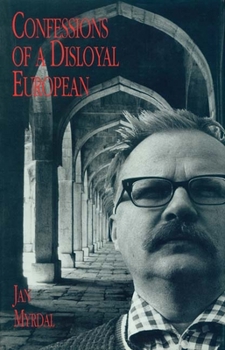
Confessions of a Disloyal European


Select Format
Select Condition 
Book Overview
This is a new edition of a sixties classic, chosen by the New York Times as one of "ten notable books" of 1968. Jan Myrdal sat down at the age of 34 to tell the truth about himself. He ended up seven years later with a book of hard truths about the generation shaped by the war against Hitler; about the next generation, shaped by the Vietnam War; and about Western intellectuals and their claims to honesty and enlightenment.
He writes without flinching about his difficult childhood years in the U.S. and Sweden, a young man facing love and betrayal, the hardships of a writer enduring poverty and censorship, and most of all the struggle to understand his times and place himself on an honest moral and political footing. He confronts these experiences and uses them, as he says, "to make the European intellectual as a type clearly visible."
Jan Myrdal observes the Western intellectual from a unique vantage point as the son of Sweden's most celebrated intellectuals, Nobel Laureates Gunnar and Alva Myrdal, engineers of the Swedish welfare state and leaders of progressive democratic thought. These family ties give a chilling resonance to Jan's questioning of the Western tradition's claims to progress and reason.
His personal journey ends dramatically as he confronts Western racism in Asia and the preventable suicide of a friend in Stockholm. The political and the personal become inseparable, and he ends with an indictment in which she spares no one, not even himself and his own attempts to break from lies and corruption.
When first published, this book was chosen by The New York Times Book Review as one of ten books of "particular significance and excellence in 1968."
The edition has a new preface by the author.
He writes without flinching about his difficult childhood years in the U.S. and Sweden, a young man facing love and betrayal, the hardships of a writer enduring poverty and censorship, and most of all the struggle to understand his times and place himself on an honest moral and political footing. He confronts these experiences and uses them, as he says, "to make the European intellectual as a type clearly visible."
Jan Myrdal observes the Western intellectual from a unique vantage point as the son of Sweden's most celebrated intellectuals, Nobel Laureates Gunnar and Alva Myrdal, engineers of the Swedish welfare state and leaders of progressive democratic thought. These family ties give a chilling resonance to Jan's questioning of the Western tradition's claims to progress and reason.
His personal journey ends dramatically as he confronts Western racism in Asia and the preventable suicide of a friend in Stockholm. The political and the personal become inseparable, and he ends with an indictment in which she spares no one, not even himself and his own attempts to break from lies and corruption.
When first published, this book was chosen by The New York Times Book Review as one of ten books of "particular significance and excellence in 1968."
The edition has a new preface by the author.
Format:Paperback
Language:English
ISBN:094170226X
ISBN13:9780941702263
Release Date:January 1990
Publisher:Univ Of Minnesota Press
Length:220 Pages
Weight:1.25 lbs.
Dimensions:8.5" x 0.5" x 5.5"
Customer Reviews
2 ratings
Memoirs of a conscious citizen of empire
Published by Thriftbooks.com User , 16 years ago
"I take it for granted that my readers remember what has been done. That they remember everything: the final solution to the Jewish question, the Stalin era, the Churchill decision to bomb the civilians, the colonial wars for plunder and freedom (with chopped-off heads in Malaya, electrodes against the genitals in Algeria, napalm in Viet Nam), OAS, the lying politicians, everything. But I want to underline that it has been the European, the Western intellectuals that have led and fulfilled these actions in every phase. We have written the theories, we have filled the universities with learned men giving rational motivations and reasonable techniques for every crime. (...) And everything that has been done has been done with the most sincere desire to carry on the struggle for our ideals. This has been the century of the European intelligentsia." Jan Myrdal, the radical son of famous economist Gunnar Myrdal and international dearmament activist Alva Myrdal, made a reckoning both with himself and his generation as well as the tradition of European intellectuals in the 20th Century in this memoir, "Confessions of a Disloyal European". Confessions, he writes, is meant not in the religious sense as much as in the old sense, as a statement of belief as well as apologia in one: Myrdal mercilessly dissects and criticizes his own psychology and actions, public and private, throughout his life, but also seeks to formulate an explanation of how he came to become one of the few intellectuals on the continent to systematically break with imperial traditions and become not just a Communist, but a Third Worldist, i.e. an anti-imperialist. (And he did not just become one, he stayed one, and even now in his old age campaigns against the present war in Afghanistan; honesty AND courage is even more uncommon.) The book is not easy to read, though it is merely 200-ish pages (in the reprint by Lake View Press, which includes a later afterword reaffirming the book). Some of the book is direct political commentary, based on the personal experiences of the author in foreign lands and with Swedish salon socialists, but most of it consists of opaque fragments written in a stream-of-consciousness-like style. These concern mostly his private affairs: his memories of poverty, of the death of his friends, of his own failures and flaws, his failed love affairs, his growing disillusionment with even the most 'social' of Western societies, his hatred of intellectual dishonesty. Much of this makes one wonder why a reader would want to know these intimate memories and self-criticisms, but Myrdal says he "wanted to get past the defense mechanisms of the reader by telling stories". One gets the feeling the stories still overwhelm the political purpose of raising consciousness to a greater degree than the author realized, probably because the mind of another is always a nocturnal marshland to the outside observer; but this is the most purposeful nonfictional account of one of Euro
a great book
Published by Thriftbooks.com User , 27 years ago
This book deals with questions of guilt, memory, personal betrayal, and societal patterns. It is extraordinarily well written and an interesting contrast to Günter Grass' Katz und Maus (Cat and Mouse) which deals with many of the same issues.
Copyright © 2026 Thriftbooks.com Terms of Use
| Privacy Policy | Do Not
Sell/Share My Personal Information | Cookie Policy | Cookie Preferences | Accessibility Statement
ThriftBooks® and the ThriftBooks® logo are registered trademarks of Thrift Books Global, LLC
ThriftBooks® and the ThriftBooks® logo are registered trademarks of Thrift Books Global, LLC
