


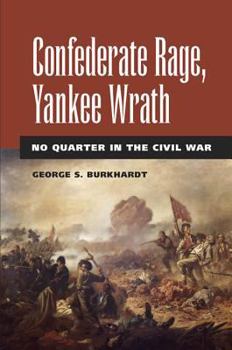
Confederate Rage, Yankee Wrath: No Quarter in the Civil War


Select Format
Select Condition 
Book Overview
This provocative new study proves the existence of a de facto Confederate policy of giving no quarter to captured black combatants during the Civil War--killing them instead of treating them as prisoners of war. Rather than looking at the massacres as a series of discrete and random events, this work examines each as part of a ruthless but standard practice.
Author George S. Burkhardt details a fascinating case that the Confederates followed a consistent pattern of murder against the black soldiers who served in Northern armies after Lincoln's 1863 Emancipation Proclamation. He shows subsequent retaliation by black soldiers and further escalation by the Confederates, including the execution of some captured white Federal soldiers, those proscribed as cavalry raiders, foragers, or house-burners, and even some captured in traditional battles.
Further disproving the notion of Confederates as victims who were merely trying to defend their homes, Burkhardt explores the motivations behind the soldiers' actions and shows the Confederates' rage at the sight of former slaves--still considered property, not men--fighting them as equals on the battlefield.
Burkhardt's narrative approach recovers important dimensions of the war that until now have not been fully explored by historians, effectively describing the systemic pattern that pushed the conflict toward a black flag, take-no-prisoners struggle.
Author George S. Burkhardt details a fascinating case that the Confederates followed a consistent pattern of murder against the black soldiers who served in Northern armies after Lincoln's 1863 Emancipation Proclamation. He shows subsequent retaliation by black soldiers and further escalation by the Confederates, including the execution of some captured white Federal soldiers, those proscribed as cavalry raiders, foragers, or house-burners, and even some captured in traditional battles.
Further disproving the notion of Confederates as victims who were merely trying to defend their homes, Burkhardt explores the motivations behind the soldiers' actions and shows the Confederates' rage at the sight of former slaves--still considered property, not men--fighting them as equals on the battlefield.
Burkhardt's narrative approach recovers important dimensions of the war that until now have not been fully explored by historians, effectively describing the systemic pattern that pushed the conflict toward a black flag, take-no-prisoners struggle.
Format:Hardcover
Language:English
ISBN:0809327430
ISBN13:9780809327430
Release Date:May 2007
Publisher:Southern Illinois University Press
Length:384 Pages
Weight:1.46 lbs.
Dimensions:9.0" x 1.0" x 6.0"
Customer Reviews
2 ratings
Compelling reading, wherever your sympathies lie.
Published by Thriftbooks.com User , 16 years ago
Massacres of surrendered or otherwise unarmed black Union troops, and their white commanders, is a VERY touchy subject in Civil War historiography. Author Burkhardt examines a host of such instances and presents fairly convincing evidence that while this was not an officially-endorsed policy of the Southern government or army, it was well-known and often ignored in the highest circles of Confederate command. Burkhardt also examines the slave-holding psyche which viewed blacks as "chattels" and not quite human, thus lessening (for some) the horrors associated with killing innocent people in horrible ways. He also explores cases in which black soldiers, especially after the "Fort Pillow Massacre" by troops under Nathan Bedford Forrest, used "Fort Pillow" as a rallying cry, exacting "no quarter" vengeance of their own in several battles with the rebels. The book is very readable, but it is filled with passages that are almost too gory to contemplate. But they MUST be contemplated, because these events actually happened. Burkhardt's conclusions about the war ending at just the right time before both sides resorted to "the black flag" on a widespread basis are right on target.
A quagmire of bad choices
Published by Thriftbooks.com User , 18 years ago
As the Civil War lengthened manpower became a problem and attitudes hardened. The South resorted to conscription but the North started to use America's Black population. This resulted in the creation of the United States Colored Troops at the national level and the designation "Colored" as part of the regimental name at the state level. Neither side was happy with this development. Both sides seem to have preferred keeping it a "white man's war" but the North decided, "Sambo should have a chance to get kilt". This decision was unacceptable to the South and resulted in the murder of USCT soldiers on a number of battlefields. This book is a history of the North's decision, the South's response and what happened on the battlefield. While most authors dismiss the South's response as racism, the book presents a more complex picture that considers many factors. Race is the foundation on which Southern response rests. Slaves enlisting in the USCT constitute a rebellion within a rebellion. This put them in violation of the servile insurrection laws existing in all CSA states. These laws dated back to colonial times, they were strengthened after Nat Turner's rebellion and a number of plots. Additionally, Blacks were considered property, giving these men the status of a bad dog that needed to be "put down". Southern society was more violent and accepting of violence than the North. Coupled with the existing racism, all of this made a policy of murder not only possible but also practical. The author covers all of this in "The Southern Perspective" grounding the reader in the social, cultural and economic mores of the area and the times. Race is also the foundation on which the North's actions rest. Blacks may have been less accepted in the North than in the South. The Emancipation Proclamation contributed the Republican Party's reverses in the election of 1862. Having created the USCT and accepted Black regiments from the states, the government is unwilling to protect their soldiers. The title could better be "Confederate Rage, Yankee Indifference". Until the end of the war both the army and the government refuses to take a firm stand as evidence mounts of sanctioned murder on the battlefield. Time after time, they either abandon Black wounded, fail to make inquires or make a pro forma protest. All of these actions are ignored or receive a bland answer that satisfied protocol. The road to the USCT is detailed in "Emancipation and Black Soldiers". These two chapters are the strongest part of the book. They are well balanced, thought provoking and show what a complex question this was. The author is unable to maintain the level of the first two chapters in the balance of the book. His grasp of the tactical details of Fort Pillow, Brice's Cross Roads and The Crater are poor. He goes beyond "An Unerring Fire" in rejecting any ideas that do not support a deliberate massacre at Fort Pillow. For Brice's Cross Roads, you need to read
Copyright © 2026 Thriftbooks.com
Terms of Use | Privacy Policy | Do Not Sell/Share My Personal Information | Cookie Policy | Cookie Preferences | Accessibility Statement
ThriftBooks ® and the ThriftBooks ® logo are registered trademarks of Thrift Books Global, LLC
ThriftBooks ® and the ThriftBooks ® logo are registered trademarks of Thrift Books Global, LLC
