


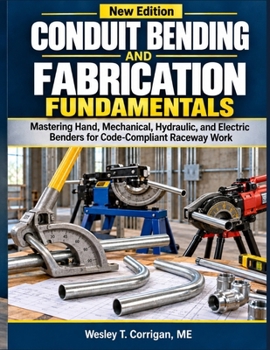
Conduit Bending And Fabrication Fundamentals: Mastering Hand, Mechanical, Hydraulic, and Electric Benders for Code-Compliant Raceway Work
No Customer Reviews

A bend that misses its mark by a fraction of an inch does not average out. Once conduit is measured, cut, and curved, the mistake is permanent - the material is wasted, and so is the time spent on it. Every apprentice learns this lesson eventually, usually at the cost of a ruined stub of pipe.
Most guides to conduit bending only solve half the problem. A pocket reference card hands over take-up values and multiplier constants that work fine until a job presents a trade size, an angle, or a bender the table does not cover. A trigonometry-heavy textbook goes the other direction, explaining the math in full but leaving the reader to bridge the gap to an actual jobsite alone - without worked field examples, without troubleshooting guidance, and without a clear answer for what to do when a bend has already gone wrong.
This book closes both gaps. Every calculation - take-up, gain, shrink, offset multipliers, springback - is taught from first principles, so an unfamiliar trade size or an unusual angle stops being a guessing exercise. Each technique is then carried through to a complete worked field example, and the book closes with a dedicated diagnostic chapter on reading a bend gone wrong, deciding whether it can be salvaged or must be scrapped, and cross-checking a bending app or coordination model against a hand calculation before trusting either one.
Readers will come away able to: Calculate take-up, gain, shrink, and offset multipliers from underlying relationships rather than memorized tablesSelect the correct conduit type and bender family for a given code requirement, environment, and trade sizeExecute hand, mechanical, hydraulic, and electric bends with a consistent setup and pre-bend verification routineBuild compound bends - back-to-back runs, saddles, offsets, kicks, and rolling offsets - that resolve correctly the first timeCoordinate multi-conduit racks and gang bending without accumulated error across a runDiagnose a failed or suspect bend, determine its cause, and decide whether it can be corrected or must be re-cutCalculate conduit fill, pull tension, and sidewall pressure using the governing equations rather than rules of thumbThe book moves through raceway materials and code-driven selection, the four families of bending tools, trade math foundations, the full progression of field bending technique, threading and fabrication, PVC and specialty conduit, support systems, fill and pull-tension calculations, and a closing chapter on diagnosing failed bends and preparing for inspection. Each chapter opens with learning objectives and closes with practice problems and a complete answer key, and a fold-out quick-reference appendix is designed to stay in a toolbox long after the first read-through.
This book is written for first-year apprentices building calculation literacy from scratch, journeyman electricians adding hydraulic or segmented bending to an existing skill set, and instructors who want a single classroom reference connecting the math to the field.
Get your copy and start turning conduit bending calculations into a repeatable, code-compliant process you can trust on every run.
Most guides to conduit bending only solve half the problem. A pocket reference card hands over take-up values and multiplier constants that work fine until a job presents a trade size, an angle, or a bender the table does not cover. A trigonometry-heavy textbook goes the other direction, explaining the math in full but leaving the reader to bridge the gap to an actual jobsite alone - without worked field examples, without troubleshooting guidance, and without a clear answer for what to do when a bend has already gone wrong.
This book closes both gaps. Every calculation - take-up, gain, shrink, offset multipliers, springback - is taught from first principles, so an unfamiliar trade size or an unusual angle stops being a guessing exercise. Each technique is then carried through to a complete worked field example, and the book closes with a dedicated diagnostic chapter on reading a bend gone wrong, deciding whether it can be salvaged or must be scrapped, and cross-checking a bending app or coordination model against a hand calculation before trusting either one.
Readers will come away able to: Calculate take-up, gain, shrink, and offset multipliers from underlying relationships rather than memorized tablesSelect the correct conduit type and bender family for a given code requirement, environment, and trade sizeExecute hand, mechanical, hydraulic, and electric bends with a consistent setup and pre-bend verification routineBuild compound bends - back-to-back runs, saddles, offsets, kicks, and rolling offsets - that resolve correctly the first timeCoordinate multi-conduit racks and gang bending without accumulated error across a runDiagnose a failed or suspect bend, determine its cause, and decide whether it can be corrected or must be re-cutCalculate conduit fill, pull tension, and sidewall pressure using the governing equations rather than rules of thumbThe book moves through raceway materials and code-driven selection, the four families of bending tools, trade math foundations, the full progression of field bending technique, threading and fabrication, PVC and specialty conduit, support systems, fill and pull-tension calculations, and a closing chapter on diagnosing failed bends and preparing for inspection. Each chapter opens with learning objectives and closes with practice problems and a complete answer key, and a fold-out quick-reference appendix is designed to stay in a toolbox long after the first read-through.
This book is written for first-year apprentices building calculation literacy from scratch, journeyman electricians adding hydraulic or segmented bending to an existing skill set, and instructors who want a single classroom reference connecting the math to the field.
Get your copy and start turning conduit bending calculations into a repeatable, code-compliant process you can trust on every run.
Format:Paperback
Language:English
ISBN:B0HKDGTLP6
ISBN13:9798175587143
Release Date:September 2026
Publisher:Independently Published
Length:208 Pages
Weight:1.09 lbs.
Dimensions:0.4" x 8.5" x 11.0"
Customer Reviews
0 rating
Copyright © 2026 Thriftbooks.com
Terms of Use | Privacy Policy | Do Not Sell/Share My Personal Information | Cookie Notice | Cookie Preferences | Accessibility Statement
ThriftBooks ® and the ThriftBooks ® logo are registered trademarks of Thrift Books Global, LLC
ThriftBooks ® and the ThriftBooks ® logo are registered trademarks of Thrift Books Global, LLC
