


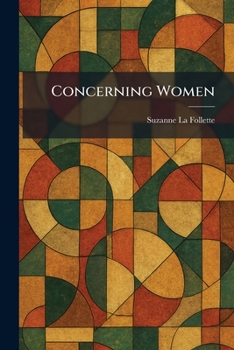
Concerning Women

Select Format
Select Condition 
Book Overview
"Concerning Women" is a seminal feminist treatise that explores the status of women in society through the lens of individual liberty and economic independence. Written by Suzanne La Follette, this influential work examines the historical and social conditions that have restricted women's progress, arguing that true emancipation requires more than just the right to vote. La Follette delves into the legal, economic, and domestic spheres, critiquing the patriarchal structures that have historically marginalized women.
The book offers a compelling analysis of the relationship between the individual and the state, advocating for a societal shift that treats women as autonomous beings entitled to the same rights and opportunities as men. By addressing issues such as labor, marriage, and institutional reform, "Concerning Women" provides a comprehensive look at the feminist movement during the early twentieth century. This work remains a significant contribution to feminist theory, offering insights into the ongoing struggle for gender equality and the importance of economic self-sufficiency in achieving personal freedom. It is an essential read for those interested in the history of women's rights and the philosophical foundations of individualist feminism.
This work has been selected by scholars as being culturally important, and is part of the knowledge base of civilization as we know it. This work was reproduced from the original artifact, and remains as true to the original work as possible. Therefore, you may see the original copyright references, library stamps (as most of these works have been housed in our most important libraries around the world), and other notations in the work.
This work is in the public domain in the United States of America, and possibly other nations. Within the United States, you may freely copy and distribute this work, as no entity (individual or corporate) has a copyright on the body of the work.
As a reproduction of a historical artifact, this work may contain missing or blurred pages, poor pictures, errant marks, etc. Scholars believe, and we concur, that this work is important enough to be preserved, reproduced, and made generally available to the public. We appreciate your support of the preservation process, and thank you for being an important part of keeping this knowledge alive and relevant.
Customer Reviews
ThriftBooks ® and the ThriftBooks ® logo are registered trademarks of Thrift Books Global, LLC
