


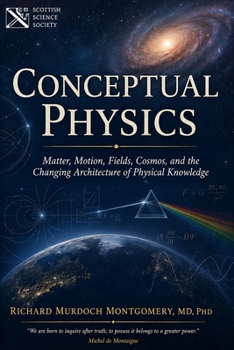
Conceptual Physics: Matter, Motion, Fields, Cosmos, and the Changing Architecture of Physical Knowledge

Why Another Conceptual Physics Book?
There is a particular kind of book that explains physics without equations,
and there is a particular kind of reader who finishes it convinced that he
has understood everything, when in truth he has merely been reassured.
The genre is a comfortable one. It offers analogies in place of arguments,
tells the reader that the universe is stranger than he supposes, and leaves
him with the pleasant sensation of having been let in on a secret. I have
read a great many such books with enjoyment and have retained from them
approximately nothing.
This book is written in the conviction that the difficulty of physics is not
mathematical. The mathematics is often merely the bookkeeping. The diffi-
culty is conceptual, and it is genuine: the ideas of physics are hard because
they require one to give up beliefs that ordinary experience has spent a
lifetime confirming. A stone thrown across a field slows and stops; it takes
a considerable act of intellectual violence to conclude from this that mo-
tion, left alone, persists forever. Experience is not a neutral witness. It is a
witness with opinions, and its opinions are frequently wrong.
What follows therefore attempts something slightly unusual. It takes the
concepts seriously enough to argue about them, and it takes the reader
seriously enough to assume he can follow an argument that lasts more
than a paragraph. It does not hide the places where physics is uncertain,
nor the more interesting places where physics was confidently, elaborately,
and productively wrong. A history of science consisting only of correct
results would be both shorter and considerably less instructive.
How to Read This Book
Every chapter is built on the same underlying frame, though I have tried to
prevent the frame from showing. We begin with a phenomenon - some-
thing that can be seen, or at least imagined vividly. We consider the expla-
nation that first suggests itself, which is usually the one humanity held for
several centuries. We then find the difficulty: the observation that the ob-
vious account cannot absorb. Competing explanations are set against one
vii Conceptual physics. Scottish Science Society.PReface
another; evidence is brought that decides between them, or fails to; and
the modern conceptual structure is assembled from what survives. Finally,
and this is the part most books omit, we ask what that structure does not
explain, and what remains genuinely unsettled.
The last three or four pages of each chapter are given over to problems,
though the word is misleading. They are not exercises in substitution. They
are disputes - an apparent paradox, a diagram to be interpreted, three stu-
dents offering incompatible accounts of the same event - and each receives
a complete worked solution in prose, because the reasoning is the whole
point and an answer key would be a species of insult.
The chapters may be read in order, and I would gently recommend it, since
the argument accumulates. But a reader who opens the book at Chapter
Twenty-Eight because he has been thinking about why ships float will not
be turned away at the door.
A Note on Mathematics
There is very little of it here, and its absence is a deliberate strategy rather
than an apology. Equations are extraordinarily good at answering ques-
tions that have already been properly posed, and extraordinarily bad at
helping one to pose them.
Customer Reviews
ThriftBooks ® and the ThriftBooks ® logo are registered trademarks of Thrift Books Global, LLC
