


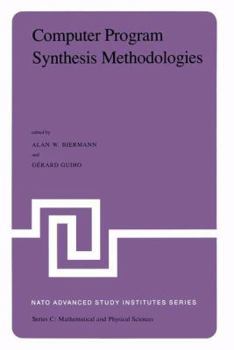
Computer Program Synthesis Methodologies: Proceedings of the NATO Advanced Study Institute Held at Bonas, France, September 28-October 10, 1981
No Customer Reviews

Select Format
Select Condition 
Book Overview
powerful operations on them. An early step in this direction was the development of APl, and more recent examples have been SETl which enables a user to code in terms of mathematical enti- ties such as sets and BDl which allows a user, presumably a businessman, to specify a computation in terms of a series of tabular forms and a series of processing paths through which data flows. The design and implementation of such languages are examined in chapters by P. GOLDBERG. Another extension to traditional methods is made possible by systems designed to automatically handle low level flow-of- control decisions. All the above higher level languages do this implicitly with their built in operators. PROLOG is a language which does this with a theorem proving mechanism employing primarily unification and backtracking. The programmer specifies the problem to be solved with a set of formal logic statements including a theorem to be proved. The theorem proving system finds a way to combine the axioms to prove the theorem, and in the process, it completes the desired calculation. H. GAllAIRE has contributed a chapter describing PROLOG giving many examples of its usage.
Format:Hardcover
Language:English
ISBN:9027715041
ISBN13:9789027715043
Release Date:December 1982
Publisher:Springer
Length:374 Pages
Weight:1.64 lbs.
Dimensions:1.0" x 6.5" x 9.6"
Customer Reviews
0 rating
Copyright © 2026 Thriftbooks.com Terms of Use
| Privacy Policy | Do Not
Sell/Share My Personal Information | Cookie Policy | Cookie Preferences | Accessibility Statement
ThriftBooks® and the ThriftBooks® logo are registered trademarks of Thrift Books Global, LLC
ThriftBooks® and the ThriftBooks® logo are registered trademarks of Thrift Books Global, LLC
