


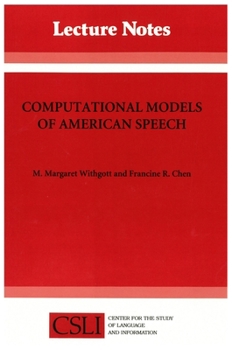
Computational Models of American Speech
No Customer Reviews

Select Format
Select Condition 
Book Overview
A new perspective on phonetic variation is achieved in this volume through the construction of a series of models of spoken American English. In the past, computer theorists and programmers investigating pronunciation have often relied on their own knowledge of the language or on limited transcription data. Speech recognition researchers, on the other hand, have drawn on a great deal of data but without examining in detail the information about pronunciation the data contains. The authors combine the best of each approach to develop probabilistic and rule-based computational models of transcription data. An ongoing controversy in studies of phonetic variation is the existence and proper definition of a phonetic unit. The authors argue that assumptions about the units of spoken language are critical to a computational model. Their computational models employ suprasegmental elements such as syllable boundaries, stress, and position in a unit called a metrical foot. The use of such elements in modeling data enables the creation of better computational models for both recognition and synthesis technology. This book should be of interest to speech engineers, linguists, and anyone who wishes to understand symbolic systems of communication.
Format:Paperback
Language:English
ISBN:0937073989
ISBN13:9780937073988
Release Date:November 1992
Publisher:Center for the Study of Language and Informat
Length:159 Pages
Customer Reviews
0 rating
Copyright © 2026 Thriftbooks.com Terms of Use
| Privacy Policy | Do Not
Sell/Share My Personal Information | Cookie Policy | Cookie Preferences | Accessibility Statement
ThriftBooks® and the ThriftBooks® logo are registered trademarks of Thrift Books Global, LLC
ThriftBooks® and the ThriftBooks® logo are registered trademarks of Thrift Books Global, LLC
