


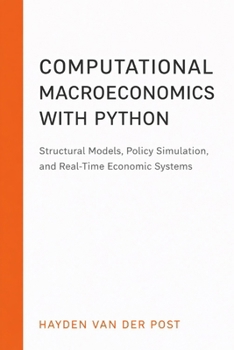
Computational Macroeconomics with Python: Structural Models, Policy Simulation, and Real-Time Economic Systems

Modern macroeconomics is no longer confined to blackboard equations or static comparative analysis. It is computational, model-driven, and increasingly implemented in code. Computational Macroeconomics with Python provides a rigorous, implementation-focused guide to building structural macroeconomic models and translating theory into executable systems.
This book bridges formal macroeconomic theory and applied computational practice. It walks through the architecture of dynamic macro models and shows how to implement, simulate, and analyze them using Python. Emphasis is placed on structural clarity, reproducibility, and policy relevance.
Inside, readers will learn how to:
Construct and solve dynamic stochastic general equilibrium (DSGE) models
Implement representative agent and heterogeneous agent frameworks
Calibrate and estimate structural parameters
Simulate monetary and fiscal policy interventions
Design policy counterfactuals and welfare comparisons
Build real-time simulation environments for economic systems
Integrate numerical methods including value function iteration, perturbation techniques, and Monte Carlo simulation
Rather than focusing on abstract exposition alone, the book demonstrates how macroeconomic systems are translated into numerical form and evaluated under alternative policy regimes. Each model is presented with conceptual grounding, mathematical structure, and complete Python implementations.
This text is designed for graduate students in economics, quantitative researchers, policy analysts, and finance professionals who require structural macroeconomic modeling in practice. Familiarity with intermediate macroeconomics and basic Python is assumed.
Computational Macroeconomics with Python is a technical guide for economists who want to move beyond theory and construct operational macroeconomic systems capable of simulation, stress testing, and policy evaluation.
Customer Reviews
ThriftBooks® and the ThriftBooks® logo are registered trademarks of Thrift Books Global, LLC
