


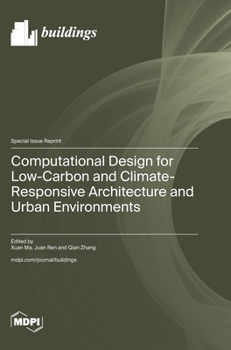
Computational Design for Low-Carbon and Climate-Responsive Architecture and Urban Environments

This Reprint presents a collection of studies on computational design for low-carbon and climate-responsive architecture and urban environments. The contributions address key challenges in the sustainable transformation of the built environment, including carbon emission accounting, daylight and thermal performance, microclimate simulation, urban spatial quality, traditional dwelling adaptation, and multi-objective building optimization. By integrating digital technologies, simulation tools, machine learning, parametric modelling, field measurement, and performance-based evaluation, this Reprint highlights how computational approaches can support evidence-based design decisions across building, neighborhood, and urban scales. The collected articles provide useful references for researchers, architects, urban designers, engineers, and policymakers working toward climate-adaptive, intelligent, and low-carbon built environments.
Customer Reviews
ThriftBooks ® and the ThriftBooks ® logo are registered trademarks of Thrift Books Global, LLC
