


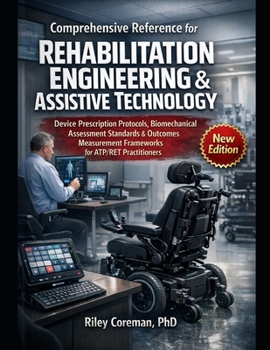
Comprehensive Reference for Rehabilitation Engineering & Assistive Technology: Device Prescription Protocols, Biomechanical Assessment Standards & Out
No Customer Reviews

WHEN THE CLINICAL QUESTION IS COMPLEX, THE DEVICE IS EXPENSIVE, AND THE FUNDING JUSTIFICATION HAS TO HOLD, THEORY IS NOT ENOUGH. Comprehensive Reference for Rehabilitation Engineering & Assistive Technology was written for practitioners who already know the landscape and now need the protocol. This is not a student overview, a broad survey of device categories, or a general rehabilitation text that stops where real practice gets hard. It is a working clinical desk reference for ATPs, RETs, occupational therapists, physical therapists, speech-language pathologists, and advanced rehabilitation clinicians who need to move from assessment findings to fundable, defensible device recommendations with confidence. THIS BOOK FOCUSES ON THE PART OF ASSISTIVE TECHNOLOGY PRACTICE THAT MOST RESOURCES LEAVE THIN: EXECUTION. Inside, you will find step-by-step assessment protocols, biomechanical seating standards, wheeled mobility prescription logic, Group 3 CRT documentation pathways, alternative drive control evaluation, AAC assessment and SGD funding guidance, computer access and EADL protocols, sensory access technology frameworks, outcomes measurement procedures, and practical documentation models for Letters of Medical Necessity, prior authorization, and appeals. The structure follows the actual AT service delivery continuum from referral intake through trial, prescription, funding, implementation, and outcomes follow-up. GET THE TOOLS CLINICIANS ACTUALLY NEED AT THE POINT OF CARE. You will get SOPs, decision trees, completed sample documents, role-based navigation, HCPCS and regulatory quick-reference material, outcomes measurement frameworks, and chapter-by-scenario routing built for daily use. This handbook is designed to help you conduct a full AT assessment, match device features to clinical findings, document medical necessity in language payers recognize, and defend the prescription when the case is reviewed by Medicare, Medicaid, or private insurance.
WHY THIS HANDBOOK IS DIFFERENT.
Most AT books explain models, definitions, and device categories. They are useful for foundational learning. They are much less useful when you are sitting with a client who needs a custom seating system, a Group 3 power wheelchair, an SGD, or a workplace access solution and the documentation has to be exact. This handbook is built for that moment. It translates frameworks such as ICF, HAAT, MPT, and SETT into usable clinical process, then carries that process through prescription writing, coding, payer-facing justification, and outcomes measurement. WHO IT SERVES BEST.
It is for the ATP who needs one reference spanning seating, mobility, AAC, access, and funding. It is for the RET who needs biomechanical and engineering depth tied directly to clinical documentation. It is for the OT, PT, or SLP practicing in AT specialty who wants stronger protocols for assessment, feature matching, trials, and LMNs. And it is for the program leader who needs better outcomes language, stronger documentation consistency, and a cleaner bridge between clinical reasoning and reimbursement.
IF YOU WANT A PRACTITIONER-GRADE HANDBOOK THAT HELPS YOU ASSESS MORE PRECISELY, PRESCRIBE MORE DEFENSIBLY, DOCUMENT MORE CLEANLY, AND MEASURE OUTCOMES MORE CREDIBLY, START HERE. Keep it open during evaluation, trial planning, LMN drafting, prior authorization review, appeal preparation, and follow-up. The best rehabilitation references do not just describe assistive technology. They help you prescribe it well. Use it when every measurement, feature choice, codes, and sentence of rationale has to connect cleanly from assessment to approval.
WHY THIS HANDBOOK IS DIFFERENT.
Most AT books explain models, definitions, and device categories. They are useful for foundational learning. They are much less useful when you are sitting with a client who needs a custom seating system, a Group 3 power wheelchair, an SGD, or a workplace access solution and the documentation has to be exact. This handbook is built for that moment. It translates frameworks such as ICF, HAAT, MPT, and SETT into usable clinical process, then carries that process through prescription writing, coding, payer-facing justification, and outcomes measurement. WHO IT SERVES BEST.
It is for the ATP who needs one reference spanning seating, mobility, AAC, access, and funding. It is for the RET who needs biomechanical and engineering depth tied directly to clinical documentation. It is for the OT, PT, or SLP practicing in AT specialty who wants stronger protocols for assessment, feature matching, trials, and LMNs. And it is for the program leader who needs better outcomes language, stronger documentation consistency, and a cleaner bridge between clinical reasoning and reimbursement.
IF YOU WANT A PRACTITIONER-GRADE HANDBOOK THAT HELPS YOU ASSESS MORE PRECISELY, PRESCRIBE MORE DEFENSIBLY, DOCUMENT MORE CLEANLY, AND MEASURE OUTCOMES MORE CREDIBLY, START HERE. Keep it open during evaluation, trial planning, LMN drafting, prior authorization review, appeal preparation, and follow-up. The best rehabilitation references do not just describe assistive technology. They help you prescribe it well. Use it when every measurement, feature choice, codes, and sentence of rationale has to connect cleanly from assessment to approval.
Format:Paperback
Language:English
ISBN:B0GWJZTZPP
ISBN13:9798255153114
Release Date:April 2026
Publisher:Independently Published
Length:324 Pages
Weight:1.66 lbs.
Dimensions:0.7" x 8.5" x 11.0"
Customer Reviews
0 rating
Copyright © 2026 Thriftbooks.com
Terms of Use | Privacy Policy | Do Not Sell/Share My Personal Information | Cookie Notice | Cookie Preferences | Accessibility Statement
ThriftBooks ® and the ThriftBooks ® logo are registered trademarks of Thrift Books Global, LLC
ThriftBooks ® and the ThriftBooks ® logo are registered trademarks of Thrift Books Global, LLC
